
The Mechanics of the Distributed Architecture Legacy
1. Architectural Trade-off Analysis: The Distributed Paradigm
To evaluate the historical paradigm objectively, executive teams must analyze both sides of the balance sheet. Distributed architectures were not a design failure; they were a highly optimized response to the operational conditions of their era.
Systematic Strengths – Why it succeeded for 30 years:
- Departmental Autonomy for Single-Domain Features: Engineering teams could rapidly specify, source, and validate features within their own domain boundaries without requiring cross-company consensus.
- Domain-Level Fault Isolation: Functional software defects were physically bounded within individual control units. A software crash in the infotainment module had normally zero physical capability to compromise the brake or steering control units.
- Predictable Tier-1 Delivery & Low Integration Risk: OEMs outsourced complete, turnkey functional packages. Fixed-price contracts and clear supplier accountability minimized OEM integration workload up to SOP.
Structural Failure Modes – Why it breaks today:
- Cross-Domain Integration Bottlenecks: Modern features (such as predictive energy management or automated driving) require real-time collaboration across powertrain, chassis, body, and sensing domains. Routing signals across multiple CAN gateways introduces extreme latency, signal fragmentation, and integration delays.
- Shared Infrastructure Vulnerabilities: Fault isolation was often illusory at the physical layer. A shorted CAN transceiver or bus physical failure could paralyze communication across multiple interconnected control units, knocking out shared network domains.
- Physical & Lifecycle Constraints: Scaling by adding ECUs resulted in unmanageable wiring harness weight, severe packaging constraints in the chassis, and an absolute inability to execute dynamic over-the-air (OTA) updates post-SOP.
- Ecosystem Bottleneck for Digital Business Models: The hardware-bound, SOP-static model prevents OEMs from introducing post-sale software monetization, continuous feature updates, or data-driven subscription services.
2. The Interdependent Evolution
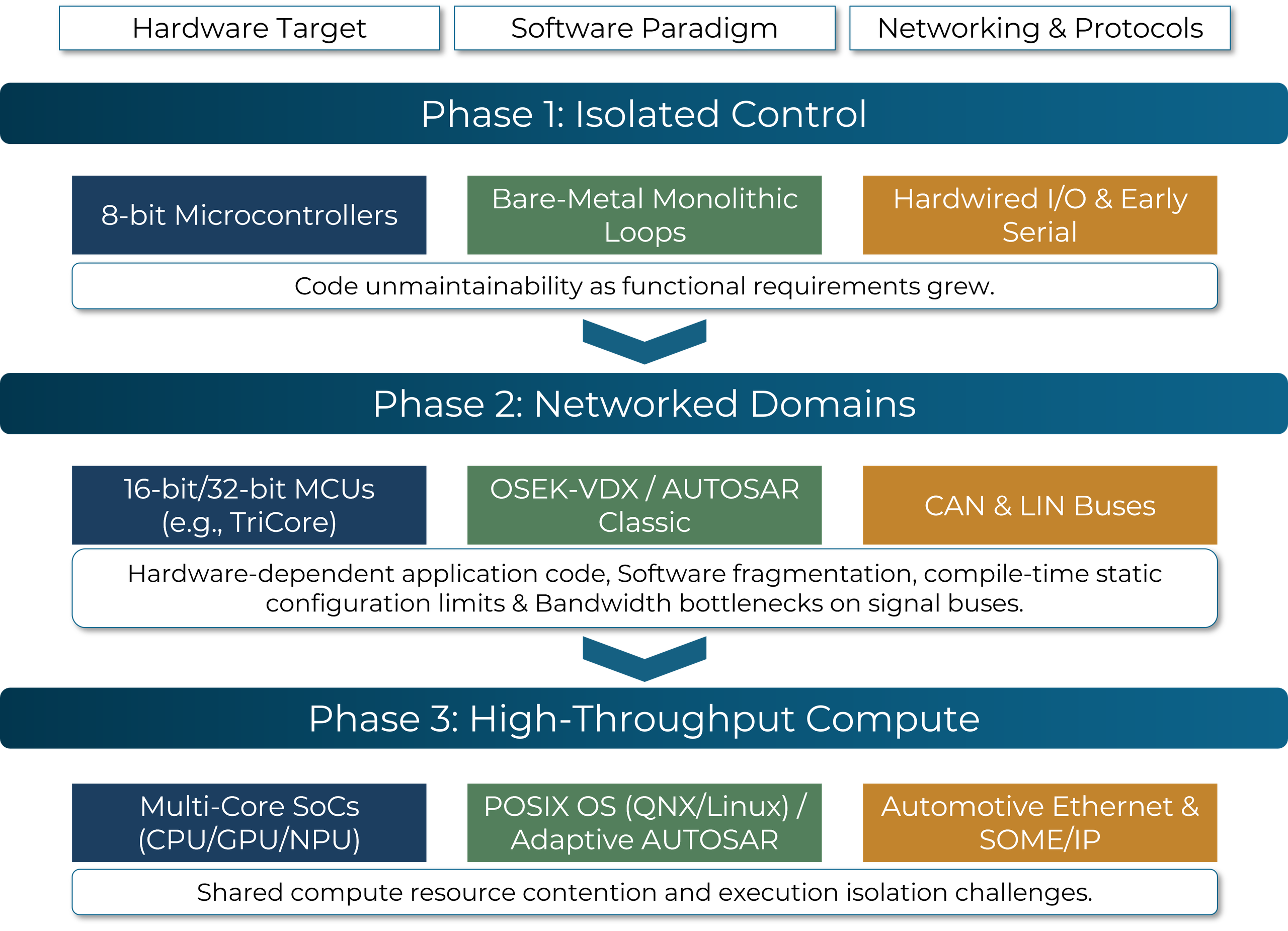
The transition across hardware, software, and networking was strictly synchronized. Bottlenecks in one dimension consistently forced structural breakthroughs in the others.
Figure 2.3 | Constraint-Driven Evolution Across Hardware, Software, and Networking
Source: LOCKS Technology Consulting
3. The Organizational Anti-Pattern: Conway’s Law in Automotive
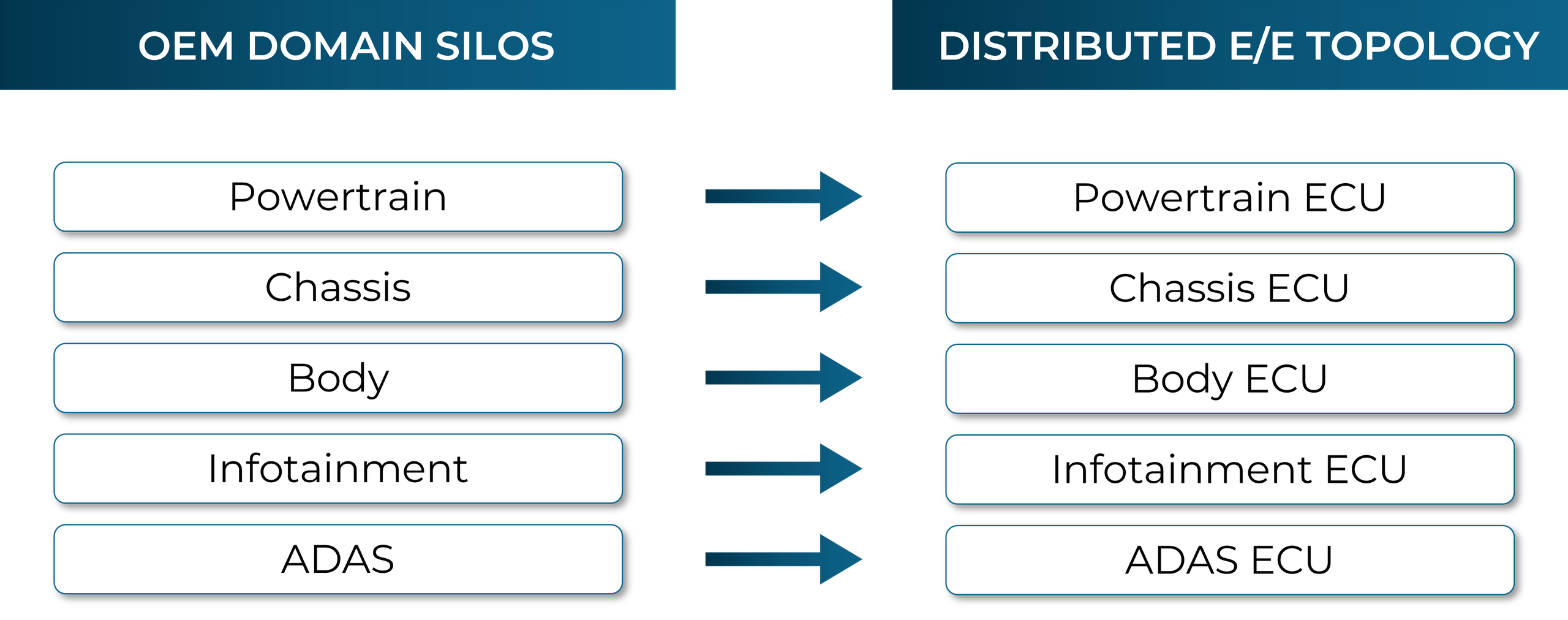
Conway’s Law states that organizations design systems that mirror their internal communication structures. In the automotive industry, this created a rigid “Organizational Mirror”:
Figure 2.4 | Conway’s Law in Automotive E/E Architectures
Source: LOCKS Technology Consulting
Result: Organizational boundaries become architectural boundaries, preventing compute consolidation.
The Self-Reinforcing Cycle:
- Mechanical Origins: OEMs created functional departments around mechanical domains (Powertrain, Chassis, Body).
- Hardware Partitioning: When microcontrollers were introduced, each domain specified its own hardware box to retain total project authority and avoid cross-departmental coordination.
- Budget & Power Cementation: ECUs became line items in domain budgets. Team size, capital allocation, and executive power became linked to managing specific ECU families and Tier-1 relationships.
- Supply Chain Alignment: Tier-1 suppliers organized their sales and engineering divisions to mirror the OEM’s domain structure, creating symmetrical, locked supply chains.
Why Legacy Sourcing Models Sabotage Centralization
When an executive board mandates compute consolidation, it directly threatens this balance. Consolidating multiple ECUs into a single domain or zonal compute engine strips individual domains of their hardware sovereignty. Departments suddenly become “tenants” on a shared computer, forced to negotiate memory, compute cycles, and software release slots with former internal rivals.
Without restructuring the underlying organization, centralized compute merely relocates complexity rather than eliminating it. The result is that architectural limits reappear as integration bottlenecks, governance conflicts, and scaling barriers at the vehicle level.