
Chapter 1
Why E/E Architecture Determines Success or Failure
Executive Summary
The Core Paradigm Shift: Automotive value creation has shifted from physical delivery at SOP to continuous software-driven lifecycle evolution.
The Strategic Risk: Legacy distributed E/E topologies act as an artificial ceiling on product capabilities, driving up BOM complexity and software warranty risks.
The Target Imperative: Architecture must evolve from an engineering discipline into a strategic business capability.
Overview
As we step into this ten-part series examining a decade of E/E transformation, we must first establish the fundamental paradigm shift governing modern automotive engineering.
- What if your E/E architecture is already defining the limits of your future business model?
- What if your E/E architecture is no longer supporting the product, but becoming the product itself?
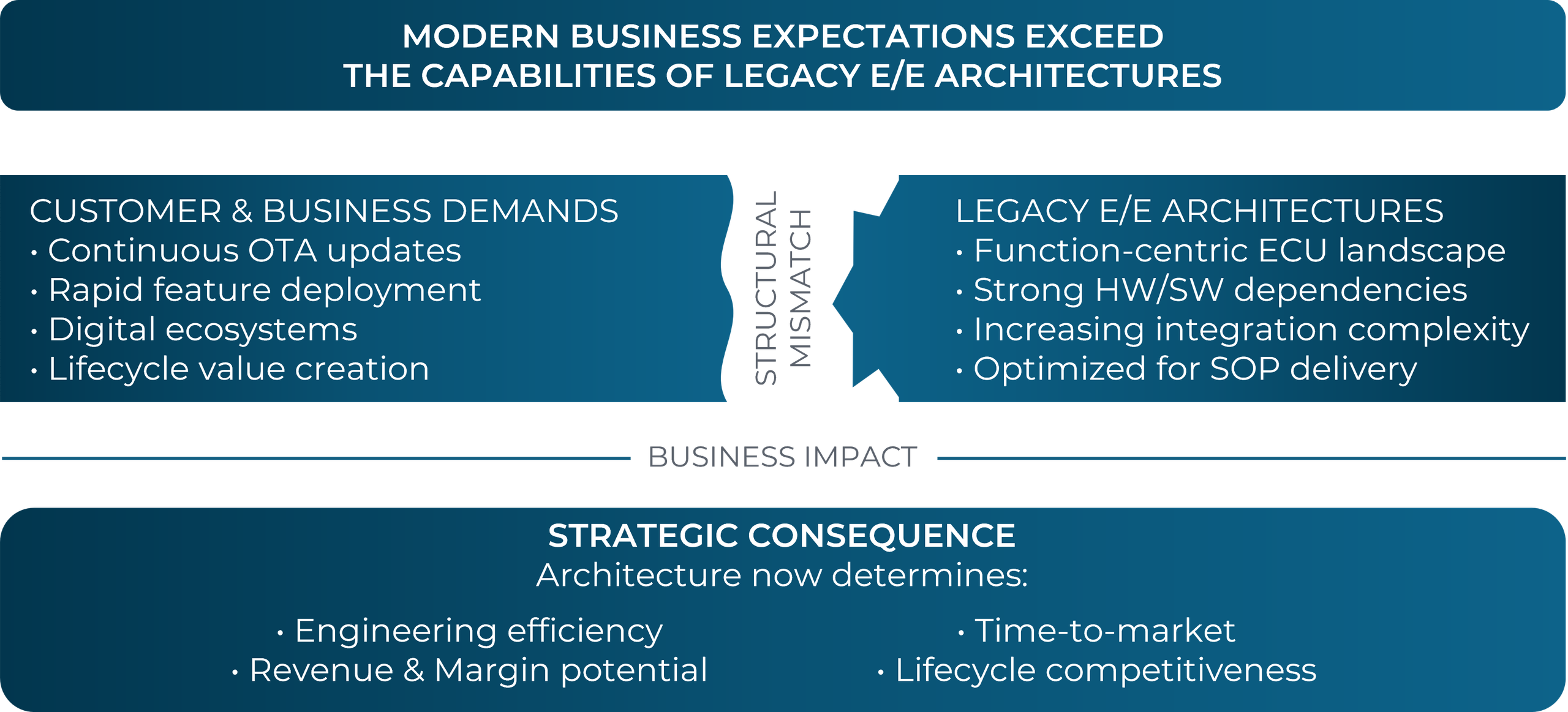
Modern E/E architecture directly governs an OEM’s long-term capability to capture value. Tying product capabilities to static physical hardware locks profit margins into traditional piece-costs subject to cost pressure. Conversely, an abstracted, future-proof architecture decouples software development from physical hardware lifecycles.
Figure 1.1 | Structural Mismatch Between Modern Business Expectations and Legacy E/E Architectures
Source: LOCKS Technology Consulting
This structural evolution touches critical business dimensions:
- Lifecycle Monetization: Unlocks post-SOP revenue potential via continuous software updates and dynamic feature delivery.
- Portfolio Scalability: Architecture defines how effectively platforms can scale across segments and product lines. This topic becomes increasingly important as we explore target architectures later in the series.
- Commercial Value Retention: Beyond technology, architecture increasingly influences the long-term value retention of fleet assets. We will revisit this aspect when discussing zonal architectures and lifecycle-driven upgradeability.
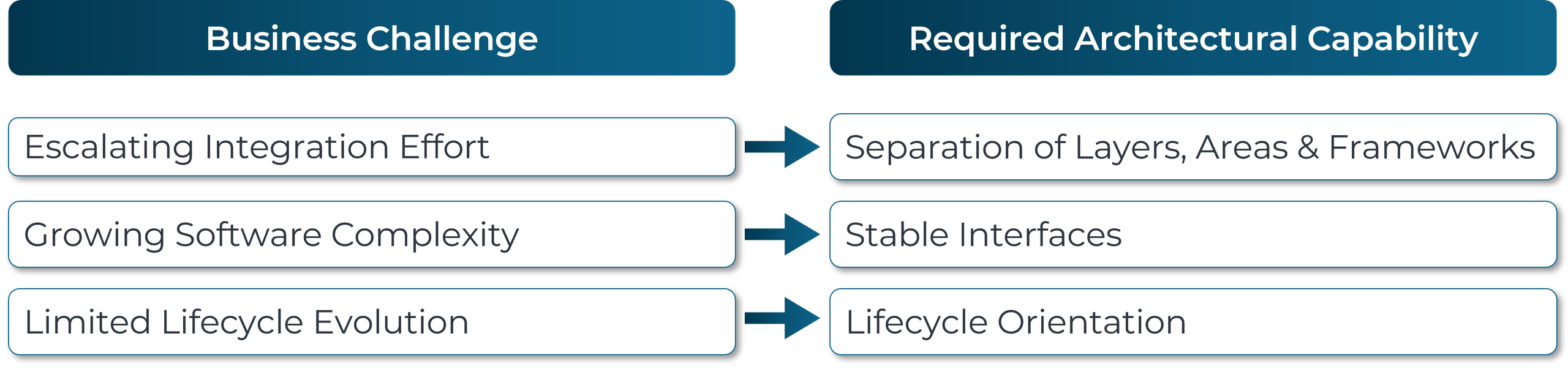
Addressing these challenges requires a set of fundamental architectural capabilities.
Figure 1.2 | Architectural Capabilities Required for Long-Term Vehicle Evolution
Source: LOCKS Technology Consulting
The challenges outlined above are symptoms of deeper architectural limitations. To support continuous software-driven evolution, modern vehicle platforms require three fundamental and solution-neutral architectural capabilities.
Continue Reading → The Foundations of Scalable Vehicle Architectures examines how architectural abstraction, interface stability, and lifecycle design transform E/E architecture from a technical discipline into a strategic business capability.
Bottom-Line & Key Takeaway
Architecture is not a support discipline; it is the ultimate capability ceiling of your enterprise. OEMs that establish the foundations for scalable vehicle architectures will unlock continuous lifecycle value creation, while those constrained by legacy distributed designs risk turning architecture into a growing barrier to innovation, scalability, and competitiveness.
Key Strategic Insight
“Architecture is not a support discipline; it is the ultimate capability ceiling of the enterprise.”
The Next Logical Step
Understanding why the E/E architecture dictates business success raises a fundamental question: how did vehicle architectures become so complex in the first place? In Chapter 2, we examine the historical evolution, tracing how decades of incremental additions created today’s integration bottlenecks.
Ready to Assess Your Architecture?
From Systems Complexity to Strategic Clarity.
Understanding the problem is the first step. The next is evaluating whether your current E/E architecture enables long-term software scalability, lifecycle monetization, and platform evolution.
Glossary
- Separation of Layers, Areas, and Frameworks: Establishing structural boundaries between physical I/O aggregation, centralized processing, and software frameworks.
- Stable Interfaces: Standardized, resilient API contracts that isolate system components from hardware and software revisions.
- Lifecycle Orientation: Engineering platforms from inception to support continuous post-SOP updates, maintenance, and functional evolution.
Series Navigation
Previous Chapter:
Start of Series