
The Foundations of Scalable Vehicle Architectures
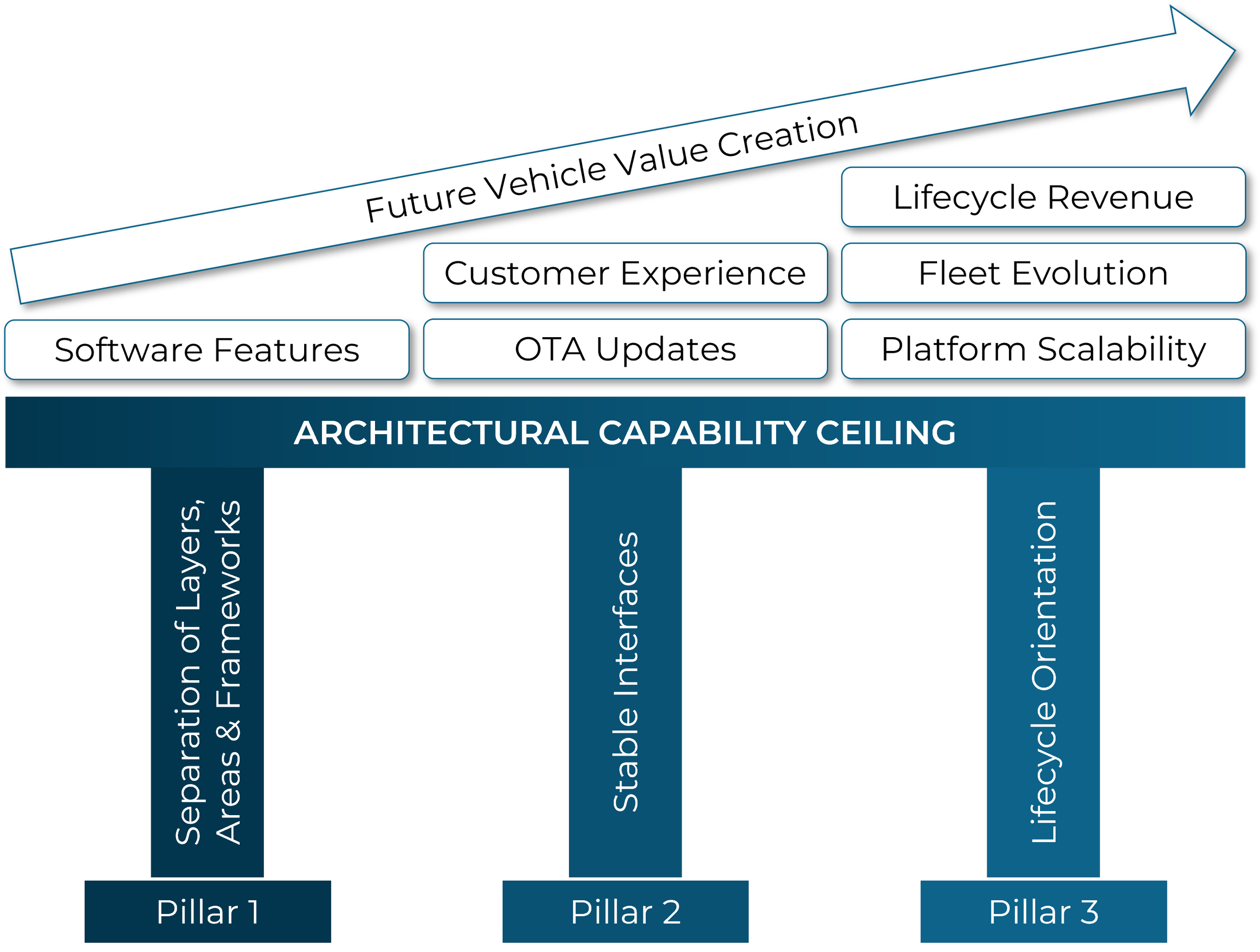
To resolve the structural mismatch present in legacy designs, modern vehicle platforms must be evaluated against three solution-neutral architectural pillars.
Figure 1.3 | Foundational Architectural Capabilities Required for Continuous Vehicle Evolution
Source: LOCKS Technology Consulting
Pillar 1: Separation of Layers, Areas, and Frameworks
Technical Definition: Establishing explicit, structural boundaries between physical I/O aggregation, centralized compute execution, and high-level application software frameworks.
Complexity Reduction: Decoupling low-level physical execution from logical application processing prevents underlying hardware changes from destabilizing upper software layers.
Execution Efficiency: Enables parallel development streams across software platforms and functional domain teams without blocking dependencies.
Pillar 2: Stable Interfaces
Technical Definition: Standardizing hardware abstraction layers, middleware interfaces, and API contracts to enforce strict isolation between system components.
System Resilience: Protects existing software functions when underlying silicon platforms, sensors, or actuators are modified or upgraded.
Integration Speed: Dramatically cuts validation overhead and prevents integration deadlocks during cross-functional software rollouts.
Pillar 3: Lifecycle Orientation
Technical Definition: Designing software architectures, memory footprints, and compute headroom from inception to support multi-year post-SOP expansion.
Continuous Evolution: Moves away from fixed “freeze-at-SOP” engineering toward continuous integration and over-the-air capability deployments.
Asset Protection: Ensures the underlying system architecture remains capable of absorbing new functional requirements throughout the operational life of the vehicle platform.
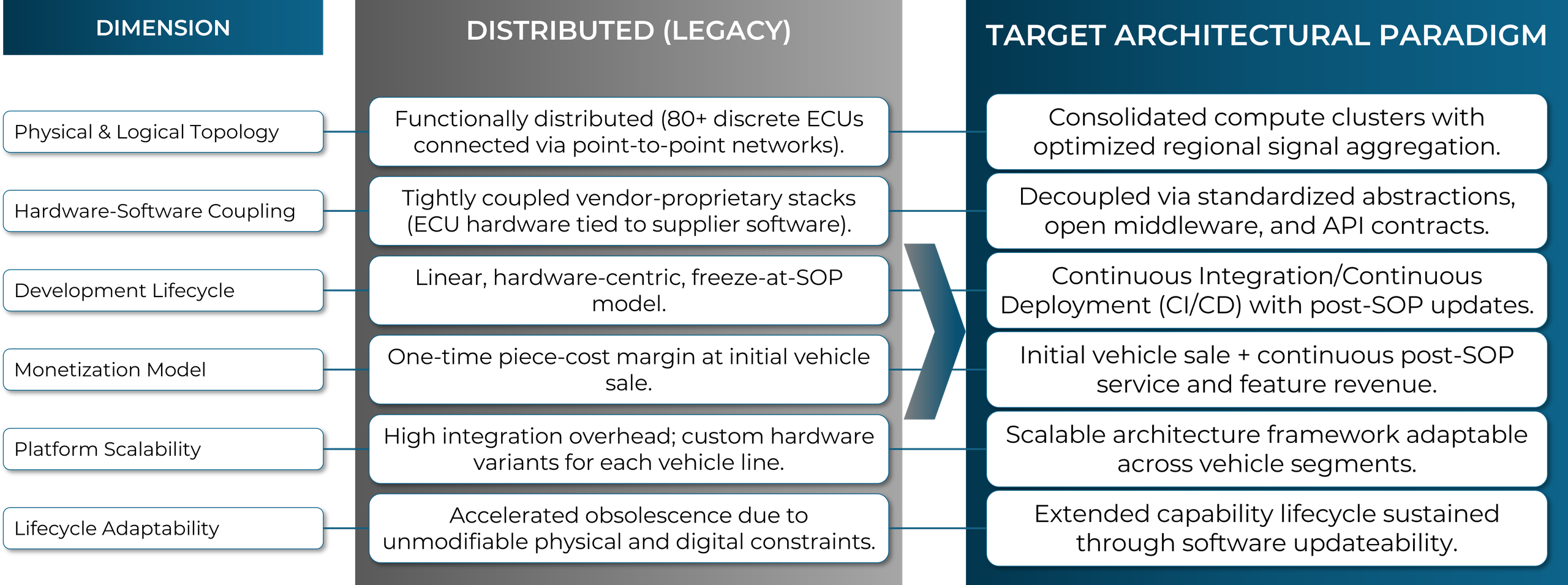
Detailed Structural Comparison
Figure 1.4 | Structural Comparison of Legacy and Future-Oriented Architectural Paradigms
Source: LOCKS Technology Consulting