
Multi-Layer Zonal Architecture, Deterministic Networking, and Hardware Provisioning
While zonal architectures are often discussed in terms of harness optimization, their true value emerges from the interaction of networking, power distribution, manufacturing, and lifecycle provisioning. The following architecture stack illustrates how ZCUs unify these traditionally independent disciplines into a scalable vehicle platform.
Figure 5.3 | The Multi-Layer Architecture Stack Behind Zonal Vehicle Platforms
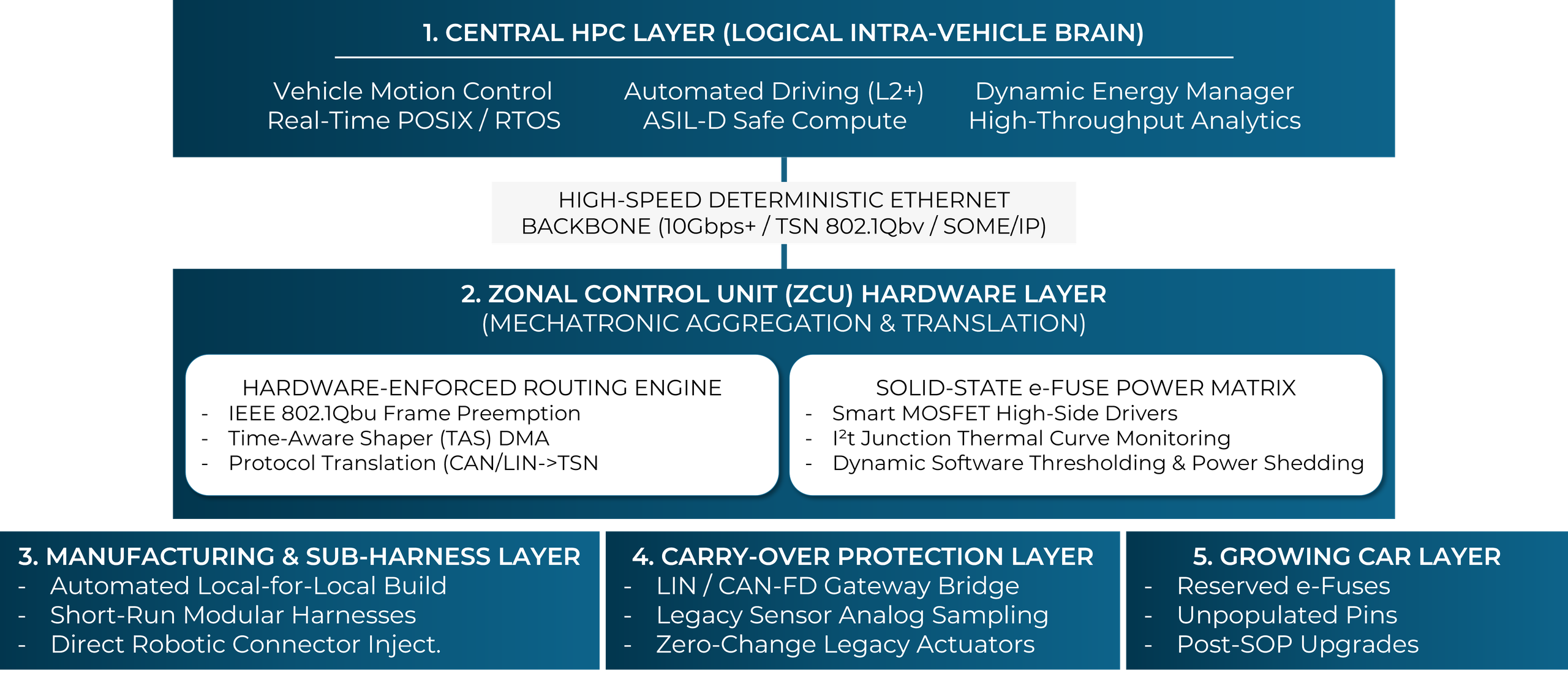
Source: LOCKS Technology Consulting
1. Deterministic Backbone Ingestion & TSN Architecture
To enable central compute execution, ZCUs must guarantee bounded latency for localized sensor inputs across the high-speed backbone.
- Time-Aware Shaping (IEEE 802.1Qbv): ZCUs execute hardware-level Time-Aware Shaping (TAS). Time-critical sensor data (e.g., wheel speed, steering angle) is mapped to dedicated cyclical time-windows, completely isolating safety traffic from bursty infotainment or diagnostic packets.
- Frame Preemption (IEEE 802.1Qbu / 802.3br): If a high-priority ASIL-D packet arrives while a low-priority jumbo frame is transmitting, the ZCU Ethernet MAC interrupts the low-priority frame at the bit-level, transmits the critical packet with sub-microsecond jitter, and resumes the background transmission.
- Hardware-Assisted Signal Transport & Encapsulation: CAN-FD and LIN frames arriving from legacy sub-networks are ingested by the ZCU’s hardware routing engine, payload-extracted, and encapsulated directly into Ethernet transport containers (or tunneled via raw Ethernet frames) via direct hardware mechanisms. This enables the lossless, zero-CPU-overhead forwarding of legacy signals across the deterministic backbone within the system.
2. Advanced e-Fuse Silicon Dynamics & Wire Protection
Replacing thermal melting fuses with semiconductor MOSFET drivers fundamentally changes the vehicle’s electrical system design:
- I²t Thermal Emulation: Smart e-Fuses continuously sample current via integrated shunt resistors or current-mirror FETs. The ZCU microcontroller executes an I²t mathematical model matching the specific thermal damage curve of the connected copper wire gauge.
- Fast Solid-State Tripping: While melting fuses require seconds to blow under minor overload conditions, an e-Fuse trips in microseconds (<10µs) during hard short-circuits. This eliminates voltage dips across the primary vehicle power rail and protects sensitive central silicon from brownout resets.
- Dynamic Energy Management & Intelligent Load Shedding: Central energy management software continuously coordinates with the ZCU to optimize vehicle-wide power distribution. Beyond shedding non-essential loads (e.g., seat heating, ambient lighting) during low-SOC or critical failure conditions, it dynamically balances energy consumption during normal operation to maximize electric range, manage thermal budgets, and strictly control quiescent current during parking states.
3. Integrated Manufacturing, Carry-Over, and Lifecycle Enablement
The ZCU integrates three critical business imperatives directly into its hardware topology:
- Automated Local Harness Manufacturing: Strategic ZCU placement breaks the traditional vehicle-wide monolithic harness into modular, manageable sections. This architectural shift enables suppliers to move away from labor-intensive manual assembly and tape-wrapping toward fully automated, robotic production lines for localized harness segments, dramatically improving manufacturing quality, reducing logistical complexity, and eliminating historical production bottlenecks.
- Carry-Over Adapter Architecture: The ZCU acts as a signal-translation buffer. Existing sensors and actuators (operating on analog, PWM, or legacy bus interfaces) interface directly with the ZCU without modification, preserving proven Tier-1 component investments while updating the core platform architecture.
- Physical Provisioning for the “Growing Car”: ZCUs provide local integration points that radically simplify post-SOP retrofits. Instead of routing a brand-new, vehicle-spanning harness through the entire car for feature expansions (e.g., adding a rear-view camera or parking sensors), installations are restricted to the local zone. By utilizing pre-allocated thermal and data interfaces at the ZCU, feature upgrades require only local wiring to the nearest zone, completely eliminating complex secondary harness overhauls across the vehicle.
4. Strategic Engineering Takeaway
The ZCU is not a passive junction box — it is a sophisticated mechatronic gateway that unifies deterministic networking (TSN), advanced solid-state power management (e-Fuse), and automated harness manufacturing. Engineering leaders must treat the ZCU as a strategic platform layer that balances real-time low-level execution with long-term platform scalability.