
Chapter 5
Zonal Architectures – Moving Beyond the Harness Optimization Myth
Executive Summary
Core Paradigm: Zonal architectures are not a mere wiring harness cost-reduction exercise; they serve as the essential physical enabler for compute centralization, software-driven lifecycle evolution, and organizational scaling.
Architectural Value Drivers: Zonal Control Units (ZCUs) unlock radical harness modularization, enable automated local-for-local manufacturing, protect legacy carry-over hardware investments, and create the physical headroom for the “Growing Car.”
Cross-Domain Execution Governance: Merging heterogeneous vehicle domains onto shared ZCUs creates immediate organizational friction over physical pinouts, power channels, and thermal envelopes that requires centralized hardware governance.
Portfolio Scalability: Zonal topologies allow OEMs to scale hardware physical configurations (Scale-In / Scale-Out) across entry-level to premium segments while maintaining a stable central software architecture.
Enabling Centralization Beyond Copper Reduction
As established in Chapter 4, centralizing compute onto High-Performance Compute (HPC) nodes promises software agility but faces severe physical, thermal, and spatial barriers if executed as a monolithic physical change.
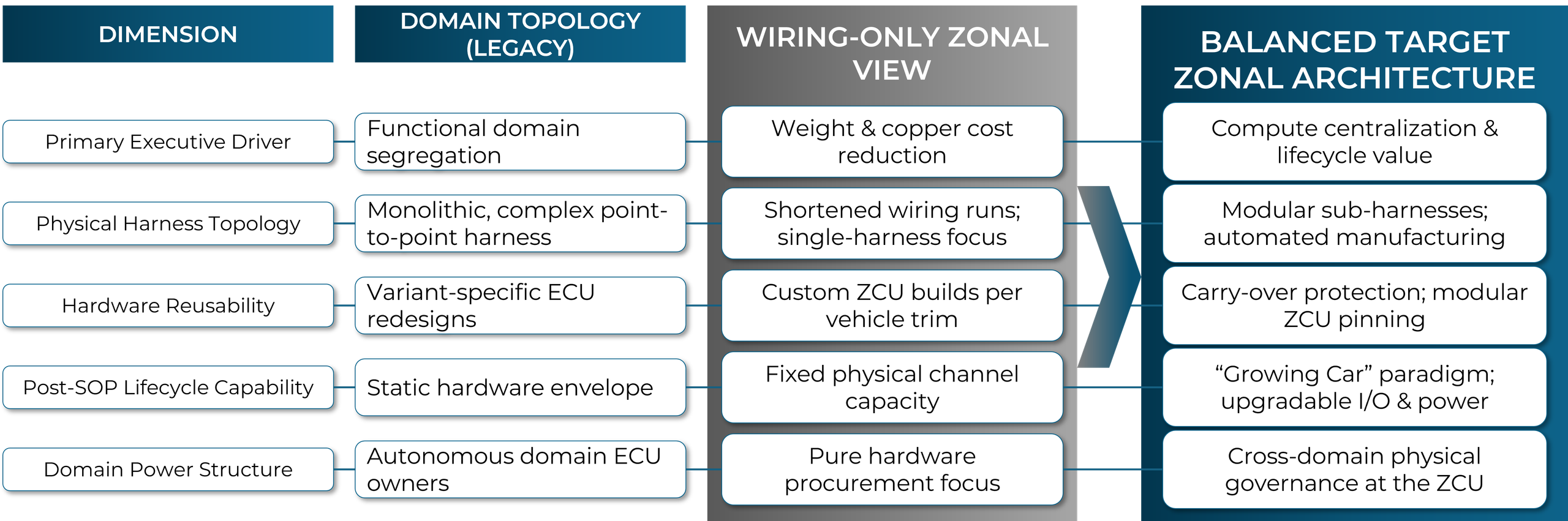
To make compute centralization physically and commercially viable, the automotive industry requires Zonal Control Units (ZCUs). A pervasive misconception in executive boardrooms is treating zonal architecture strictly as a wiring harness optimization project measured in kilograms of copper saved. While weight reduction is a welcome byproduct, treating it as the primary objective hides the true strategic rationale:
Zonal architecture is the physical enabler of compute centralization and continuous platform evolution.
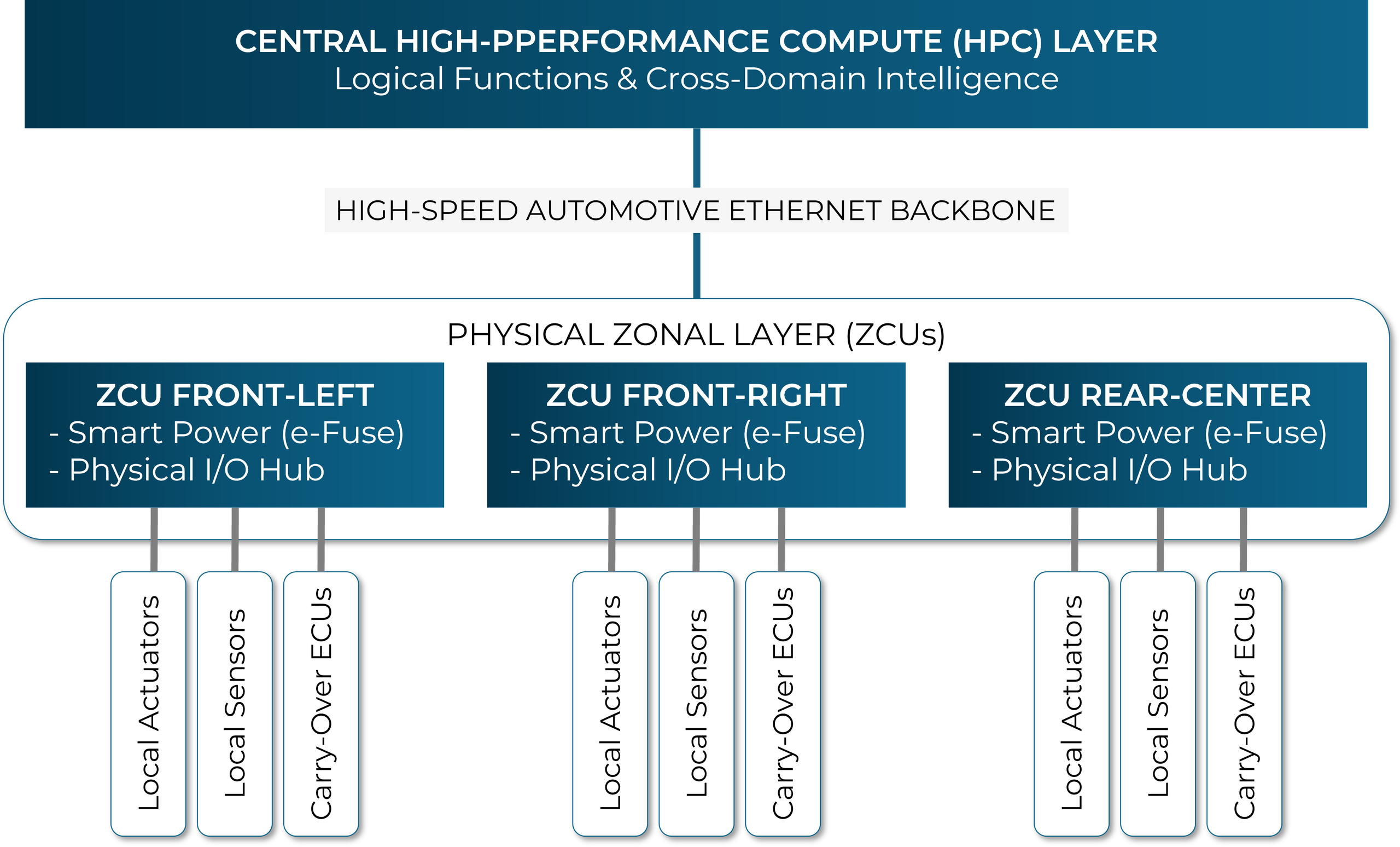
ZCUs decouple physical vehicle topology from logical software architecture. By moving from domain-bound ECUs to geographic zonal hubs, OEMs solve three fundamental platform challenges:
Figure 5.1 | The Physical Foundation of Compute Centralization
Source: LOCKS Technology Consulting
- Harness Modularization & Local-for-Local Manufacturing: Traditional complex, vehicle-spanning wiring harnesses cannot be fully automated during production and force reliance on manual assembly. ZCUs break the monolithic harness into localized, modular sub-harnesses. This enables automated, high-quality local-for-local manufacturing and radically reduces assembly complexity on the OEM line.
- Carry-Over Protection: Platform transformations fail when every single sensor and actuator must be redesigned simultaneously. ZCUs act as protective physical adapters, allowing legacy sensors, actuators, and LIN/CAN sub-networks to carry over seamlessly while central applications migrate to cloud-native paradigms.
- The “Growing Car” (Post-SOP Lifecycle Evolution): Centralized software updates are useless if the physical vehicle lacks power and I/O headroom. Dimensioning ZCUs with reserved power channels and expandable I/O slots establishes the physical foundation for the “Growing Car” — allowing OEMs to sell hardware upgrades, aftermarket accessories, and feature-on-demand enhancements long after SOP.
Continue Reading → Multi-Layer Zonal Architecture, Deterministic Networking, and Hardware Provisioning explores how deterministic Ethernet networking, smart power distribution, legacy protocol integration, and lifecycle-ready hardware provisioning enable scalable zonal vehicle platforms.
Figure 5.2 | From Harness Optimization to Platform Architecture
Source: LOCKS Technology Consulting
Cross-Domain Governance: Managing Cross-Domain Convergence
While ZCUs simplify physical vehicle geometry, they introduce intense organizational friction by forcing cross-domain convergence at the physical interface. On a forward ZCU, components from Body (lighting), Passive Safety (crash sensors), Chassis (steering inputs), and HVAC (actuators) terminate into the exact same physical housing.
This triggers immediate organizational turf wars:
- Resource Contention at the Pin Level: Domain heads fight over high-side driver channels, physical pin allocations, and thermal dissipation budgets inside the shared ZCU enclosure.
- The Inter-Domain Dependency Trap: If the Chassis team delays a connector specification or physical sign-off, the shared ZCU hardware layout freezes—blocking the SOP timeline for Body and HVAC teams.
Governance Solution: OEMs must establish clear Physical ZCU Governance. The zonal hardware team acts as an internal infrastructure provider managing the ZCU housing, connector footprints, e-Fuse protection logic, and physical pin allocations. Domain teams act as functional customers interfacing with the ZCU through standardized hardware interface requirements.
Portfolio-Wide Zonal Control Unit (ZCU) Hardware Scalability
To maximize return on R&D investment, zonal hardware must scale horizontally across vehicle segments without fracturing platform architecture:
- Modular Topologies (Scale-In vs. Scale-Out): Entry-level vehicles utilize a compact 2-ZCU setup (Front/Rear), while luxury and high-performance segments scale horizontally to a 4-ZCU layout (Front-L, Front-R, Rear-L, Rear-R) to accommodate advanced sensor grids.
- Population Options (Pop vs. No-Pop): ZCU printed circuit boards (PCBs) are designed with standardized trace layouts. Scaling across vehicle trims is achieved by populating or unpopulating power switches and driver stages on the same base PCB.
- Stable Logical Mapping: Upstream application logic on central High-Performance Compute (HPC) remains untouched when scaling physical ZCU variants, ensuring total decoupling between physical segment scaling and core software investment.
Bottom-Line & Key Takeaway
Zonal architectures are not a mere weight-saving exercise — they are the indispensable physical foundation for compute centralization, automated harness manufacturing, and post-SOP vehicle evolution. Executive success requires steering clear of copper-only metrics, protecting carry-over investments, and actively governing the cross-domain physical friction created when heterogeneous vehicle domains merge onto shared ZCU hardware.
Key Strategic Insight
“Centralized compute scales through software.
Zonal architectures make it scale in the physical vehicle.”
The Next Logical Step
Having established the physical foundation, localized power distribution, and deterministic networking of zonal architectures, we must now transition from hardware topology to the software layer — examining how standardized operating systems, Service-Oriented Architecture (SOA), and rigorous systems engineering turn the vehicle into a scalable, lifecycle-managed Software-Defined Vehicle.
Ready to Build a Zonal Architecture?
From Systems Complexity to Strategic Clarity.
Zonal architectures are far more than a harness optimization exercise. They form the physical foundation for centralized compute, scalable platforms, and lifecycle-ready vehicles.
Glossary
- Carry-Over Protection: An architectural strategy using ZCUs to translate legacy sensor/actuator interfaces, allowing existing hardware components to be reused in next-generation platform topologies.
- e-Fuse (Smart Power Distribution): Solid-state power switches integrated into ZCUs that replace mechanical relays and fuses, providing programmable channel protection and real-time load diagnostics.
- Growing Car: An architectural paradigm where physical power headroom, compute capacity, and ZCU I/O expansion slots are pre-provisioned to support post-SOP hardware updates and over-the-air feature activation.
- Zonal Control Unit (ZCU): A physical aggregation node that consolidates localized I/O, smart power distribution, and protocol translation within a defined physical region of the vehicle.