
Chapter 4
Centralization of Compute – Beyond the Monolithic Myth
Executive Summary
Core Paradigm: Compute centralization is an integration spectrum, not a binary choice or a monolithic “one-big-computer” destination.
Logical vs. Physical: Successful platforms prioritize logical centralization first — decoupling application logic from physical hardware through standardized service interfaces — before optimizing physical High-Performance Compute (HPC) topologies.
Systems Engineering as the Foundation: Centralized compute platforms only succeed when interfaces, safety concepts, resource budgets, and lifecycle requirements are governed through end-to-end systems engineering from the outset. Without this discipline, integration complexity resurfaces later as validation delays, quality issues, and launch risks.
Portfolio Scaling: Centralized compute architectures must scale horizontally across the vehicle portfolio — from entry-level models using compact compute clusters to premium vehicles with expanded multi-node High-Performance Compute (HPC) resources — while preserving a single, unified software platform.
Loss of Hardware Sovereignty: Centralization strips domain leads of dedicated hardware, converting former “ECU owners” into mere “software tenants” on shared compute platforms.
Organizational Friction: Merging fast-paced UI teams and strict safety engineers onto shared silicon triggers severe cultural clashes and exposes process-fat bureaucracy.
Breakdown of Supplier Symmetry & Liability: Consolidating hardware dissolves traditional 1:1 OEM-to-Tier-1 supply models, requiring OEMs to own the middleware, manage multi-party liability via strict API contracts, and enforce vECU release governance.
From Distributed Chaos to Compute Consolidation
As established in Chapter 3, legacy E/E topologies collapsed under the weight of exponential variant growth, physical harness limits, and late-stage integration bottlenecks. To break through this scaling wall, the automotive industry has embarked on a systematic path toward compute consolidation. Bringing software functions together onto fewer, far more powerful High-Performance Compute (HPC) nodes promises to eliminate redundant hardware, enable service-oriented architectures (SOA), and unlock rapid over-the-air (OTA) updates.
However, the transition toward centralized compute is frequently mismanaged. Many OEM initiatives fall into the trap of oversimplified target architectures or attempt to consolidate hardware without altering underlying organizational structures.
Figure 4.1 | Compute Centralization Spectrum
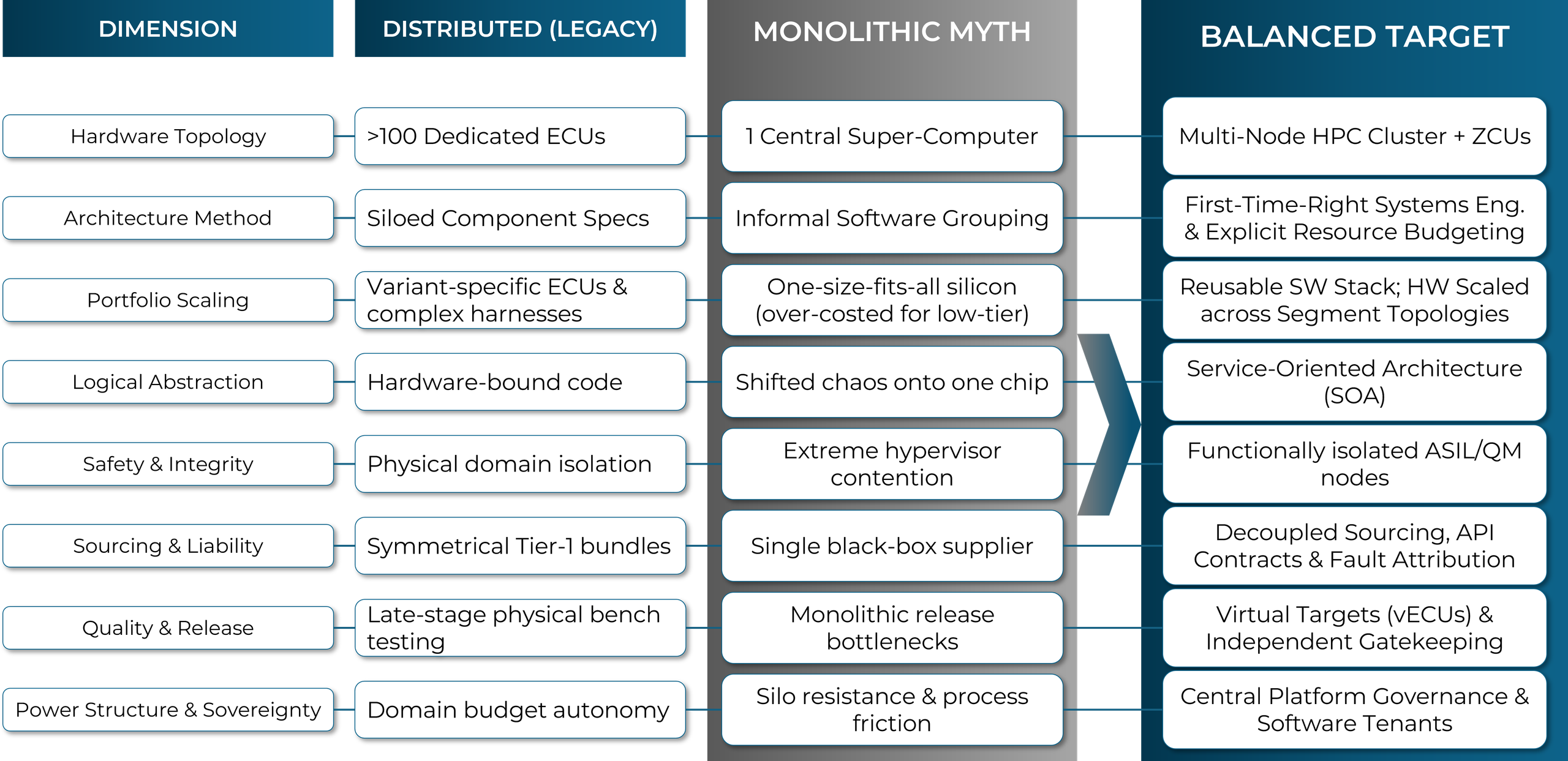
Source: LOCKS Technology Consulting
Deconstructing the “One Big Computer” Myth
The most pervasive misconception in executive boardrooms is that a Software-Defined Vehicle requires consolidating all vehicle functions onto a single central processor. Forcing every domain onto one chip violates three fundamental principles of automotive engineering:
- Safety and Freedom from Interference (ISO 26262): Hosting non-critical, high-throughput software (such as rich user interfaces running at QM or ASIL-A) alongside deterministic, time-critical functions (such as vehicle motion control at ASIL-D) on a single physical System-on-Chip (SoC) creates severe mixed-criticality conflicts. Even with safety hypervisors and hardware Quality-of-Service (QoS) mechanisms, memory-bus contention and safety validation efforts explode exponentially.
- Fail-Operational Redundancy: Whenever loss of functionality is unacceptable, centralized vehicle architectures require redundant paths and fault-tolerant system designs to avoid single points of failure.
- Thermal and Packaging Bottlenecks: Concentrating multi-teraflop-class processing power into a single location creates severe liquid-cooling demands and unmanageable wiring connector clusters.
Systems Engineering & Portfolio Reusability
1. Systems Engineering as the Core Discipline
Centralized compute shifts the critical path from physical hardware delivery to logical system integration. Attempting compute consolidation without rigorous, end-to-end Systems Engineering inevitably leads to late-stage development crises. Systems Engineering serves as the foundational discipline that defines:
- First-Time-Right Integration: Clean functional decomposition, precise interface contracts, and unambiguous end-to-end signal latency paths before silicon layout or software coding begins.
- Rigorous Resource Allocation: Explicit bounding of CPU compute cycles, L2/L3 cache reservations, DRAM bandwidth allocation, and thermal budgets per functional tenant.
- Safety & Security Envelopes: System-level traceability that maps hazard analysis (HARA) directly to hardware spatial/temporal isolation boundaries.
Without strict Systems Engineering governance, software integration defaults to an iterative trial-and-error process on physical test benches, leading to severe validation delays and unpredicted launch risks.
2. Portfolio-Wide Compute Scaling
A centralized architecture must not be engineered as a static, single-vehicle solution. To maximize return on R&D investment, OEMs require a platform strategy where software assets scale seamlessly across entire vehicle portfolios:
- Common Software Baseline: A single, standardized middleware, OS layer, and application service framework shared across all vehicle tiers.
- Modular Compute Topologies: Entry-level vehicle segments deploy compact, highly integrated compute clusters with trimmed SoC configurations. Premium segments scale horizontally by integrating additional High-Performance Compute (HPC) nodes and high-performance neural processing units (NPUs).
- Decoupled Lifecycle Costs: Scaling hardware dimensioning up or down per segment without modifying core software architecture protects R&D efficiency and maintains software reusability across platform lifecycles.
The Organizational Conflict: Power Wars, Bureaucracy, and Cultural Clashes
Centralizing hardware is never just an engineering task; it is a fundamental restructuring of corporate power structures. When silicon consolidates, organizational friction surfaces along three distinct fault lines:
1. Loss of Hardware Sovereignty: From ECU Owners to Software Tenants
In distributed legacy architectures, domain heads (Chassis, Powertrain, Body, Infotainment) operated as largely autonomous technology owners. They held absolute authority over dedicated ECU hardware budgets, physical connector pins, and direct relationships with Tier-1 suppliers.
Compute centralization dismantles this empire. When domain-specific ECUs are dissolved into a shared central High-Performance Compute (HPC), ownership of dedicated hardware disappears. Engineering organizations become software tenants on shared compute resources rather than owners of their own silicon.
Access to CPU cores, RAM, memory bandwidth, and flashing capacity is controlled through a centralized Platform & System Integration Team. The resulting loss of autonomy often triggers budget defense, competing priorities, and resistance to architecture migration as established organizational structures are challenged.
2. Process-Fat Bureaucracy
Legacy OEM organization charts are optimized for static, hardware-bound development cycles. Decades of organizational evolution have created a “process-fat bureaucracy” — armies of release managers, change-control boards, and sign-off auditors built around physical component milestones (A-Sample, B-Sample, SOP).
When applied to a centralized software-defined platform, this bureaucracy becomes paralyzing. Requiring a 30-page change request and a multi-week sign-off board for a minor software bugfix on a shared High-Performance Compute (HPC) node destroys the velocity gains promised by centralization.
3. Cultural Clash Between Domains
Shared High-Performance Compute (HPC) platforms force teams with fundamentally incompatible engineering cultures into intimate operational proximity:
- The Cloud/Infotainment Culture: Accustomed to web-scale development, rapid 2-week agile sprints, dynamic memory allocation, open-source stacks, and frequent post-SOP updates.
- The Safety/Functional Control Culture: Rooted in deterministic real-time behavior, multi-year V-model planning, strict static memory allocation, and zero-risk ISO 26262 compliance.
When these two worlds share a single SoC and a unified integration pipeline, friction is inevitable. Infotainment developers view safety processes as innovation-killing red tape; safety engineers view agile web developers as reckless hazards to vehicle integrity. Without central governance enforcing clean interface boundaries, these cultural clashes derail vehicle launches.
Figure 4.2 | The Organizational Rift in Centralized Compute
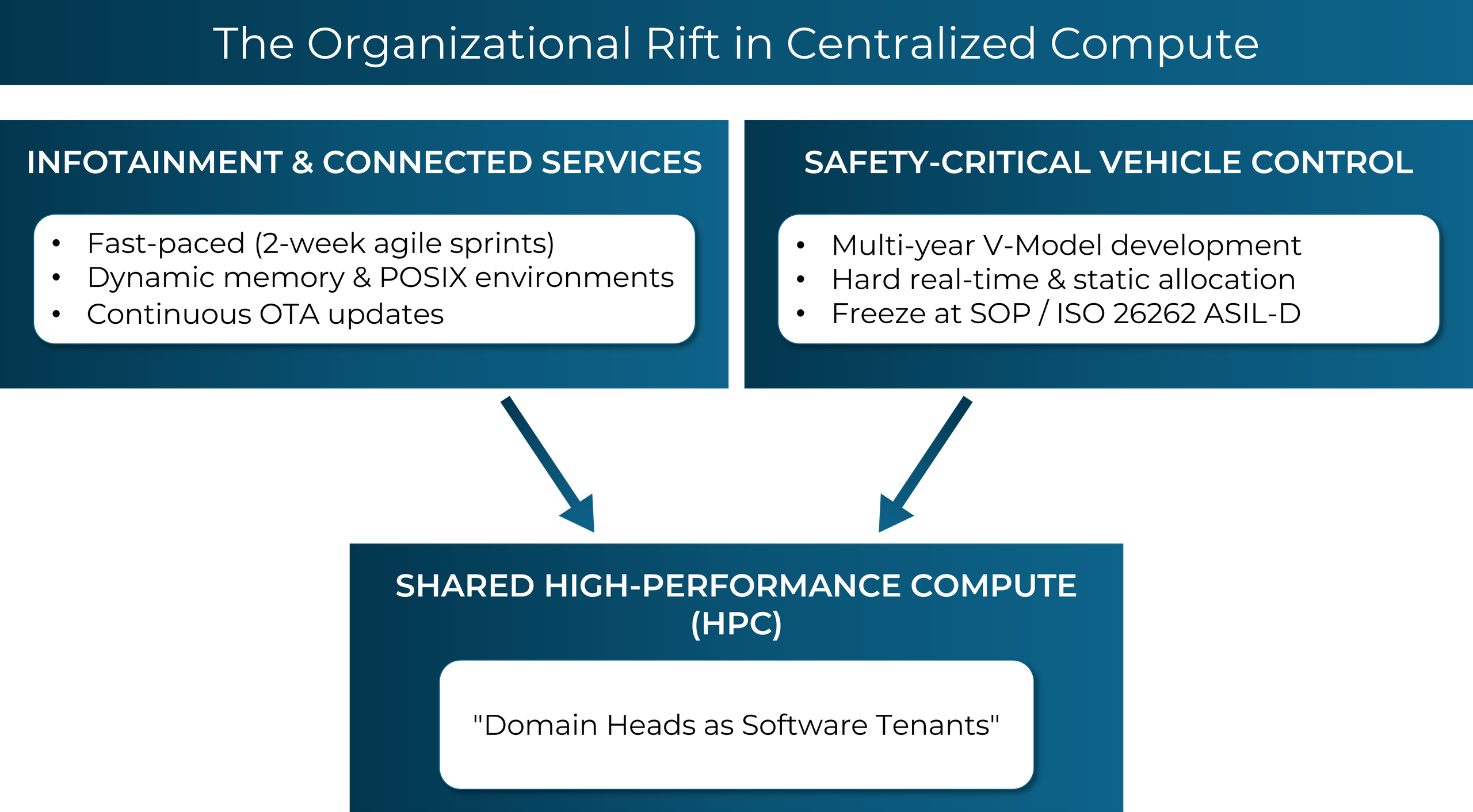
Source: LOCKS Technology Consulting
Continue Reading → Mixed-Criticality Integration, Hypervisors, and Hardware QoS explores how safety-critical and non-safety-critical workloads coexist on shared compute platforms, how hypervisors and hardware isolation mechanisms protect system integrity, and why freedom from interference has become a foundational requirement for modern centralized vehicle architectures.
Supply Chain Governance: Liability, Quality Pipelines & Supplier Decoupling
1. Dissolution of Supplier Symmetry
Legacy E/E development relied on a symmetrical structure: each OEM domain department interacted directly with a dedicated Tier-1 supplier who delivered a complete, black-box ECU containing hardware, board support packages, and application logic. Centralizing compute onto multi-domain High-Performance Compute (HPC) destroys this model. OEMs can no longer delegate complete integration responsibility to a single supplier without risking critical vendor lock-in. Internal teams must assume direct ownership over system architecture, middleware layers, and integration platforms.
Figure 4.3 | The Shift in Automotive Supply Chain Sovereignty
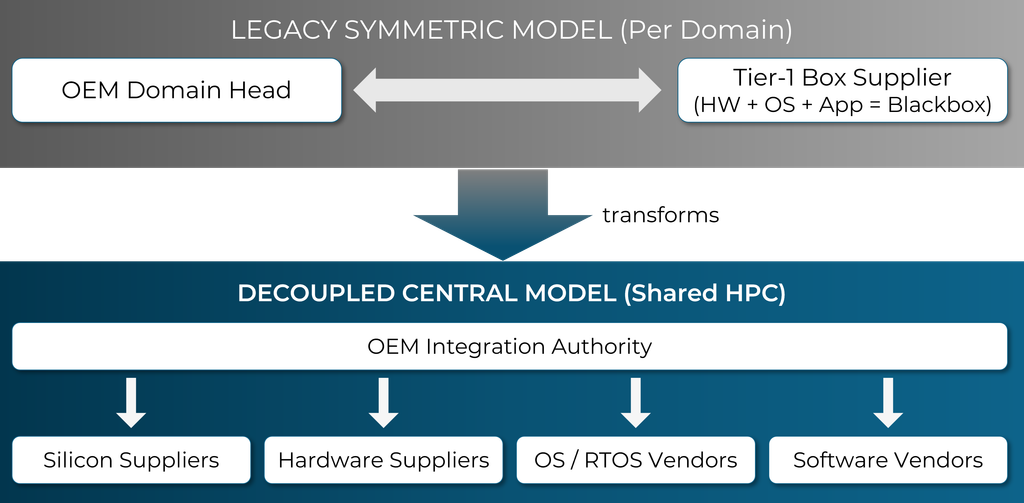
Source: LOCKS Technology Consulting
This shift does not diminish the importance of suppliers. Instead, it changes where value is created. As OEMs assume greater responsibility for system integration, suppliers increasingly differentiate through application software, platform services, functional expertise, and long-term lifecycle support. Success is no longer defined solely by delivering a complete hardware product at SOP, but by contributing capabilities that remain valuable throughout the vehicle lifecycle.
2. Multi-Party Liability & Fault Attribution
When system faults occur on a shared High-Performance Compute (HPC) — such as thread starvation on a memory bus — determining liability among multiple software vendors becomes impossible without structural safeguards. Mitigating multi-party liability risks requires two core mechanisms:
- Contractual & Technical API Boundaries: Every software component must be bounded by strict execution budgets (CPU cycles, memory allocation, bus bandwidth) enforced at compile-time and run-time.
- Automated Fault Attribution: Embedded diagnostic monitors and hypervisors must log policy violations in real-time to attribute root-cause fault ownership unequivocally during runtime failures.
3. Quality & Release Governance
Integrating software from dozens of internal and external sources fails when teams operate on conflicting release cadences. Modern release governance relies on two structural pillars:
- Virtual Target Testing (vECU): CI/CD pipelines validate software builds against cloud-hosted virtual targets (vECUs), decoupling software testing from physical silicon availability.
- Independent Four-Eyes Quality Gatekeeping: Release decisions are moved out of individual domain groups and assigned to an independent software quality organization using automated threshold checks.
Bottom-Line & Key Takeaway
Compute centralization is an integration spectrum, not a monolithic destination. Executive success depends on strictly separating logical software centralization from physical hardware topology, grounded in rigorous Systems Engineering to ensure First-Time-Right execution. Master the shift from “ECU ownership” to “software tenancy” by enabling portfolio-wide compute scalability, replacing process-fat bureaucracy with automated virtual target pipelines, and establishing central integration sovereignty. Decoupling software from silicon is the only viable way to master mixed-criticality constraints, de-risk supplier sourcing, and preserve a lifecycle-ready architecture.
Key Strategic Insight
“The goal is not one computer. The goal is one software platform.”
The Next Logical Step
To look beyond the central compute nodes and analyze how zonal topologies solve the physical packaging, wiring, and connector constraints of compute consolidation.
Ready to Centralize Compute Successfully?
From Systems Complexity to Strategic Clarity.
Compute consolidation is not about building one large computer. It is about establishing the governance, systems engineering, and platform foundations required for scalable software execution.
Glossary
- First-Time-Right Engineering: A systems engineering methodology focusing on complete, unambiguous interface and resource definition prior to implementation to eliminate late-stage rework.
- High-Performance Compute (HPC): Multi-core, high-throughput processing nodes (SoCs) designed to execute centralized, compute-heavy software workloads across vehicle domains.
- Logical Centralization: The architectural decoupling of software functions from specific physical hardware, allowing them to communicate via unified service interfaces.
- Multi-Party Liability: The legal and technical challenge of attributing fault, warranty, and liability claims when software from multiple vendors runs concurrently on shared hardware.
- Portfolio Scaling: The architectural capability to run a standardized software stack across varying hardware compute tiers scaled to different vehicle market segments.
- Software Tenant: A functional domain or software team that does not own dedicated hardware, but instead executes its application logic as a hosted tenant on a shared compute platform.
- Supplier Symmetry: The traditional automotive sourcing model where an OEM functional department maps 1:1 to a single Tier-1 system supplier delivering a complete ECU.
- Systems Engineering: An interdisciplinary engineering discipline focusing on system architecture, requirements traceability, interface management, and system integration across lifecycle domains.
- Virtual Target (vECU): A cloud-hosted or emulated software abstraction of target hardware used for automated testing in CI/CD pipelines.