
Mixed-Criticality Integration, Hypervisors, and Hardware QoS
Central High-Performance Compute (HPC) Architecture Stack
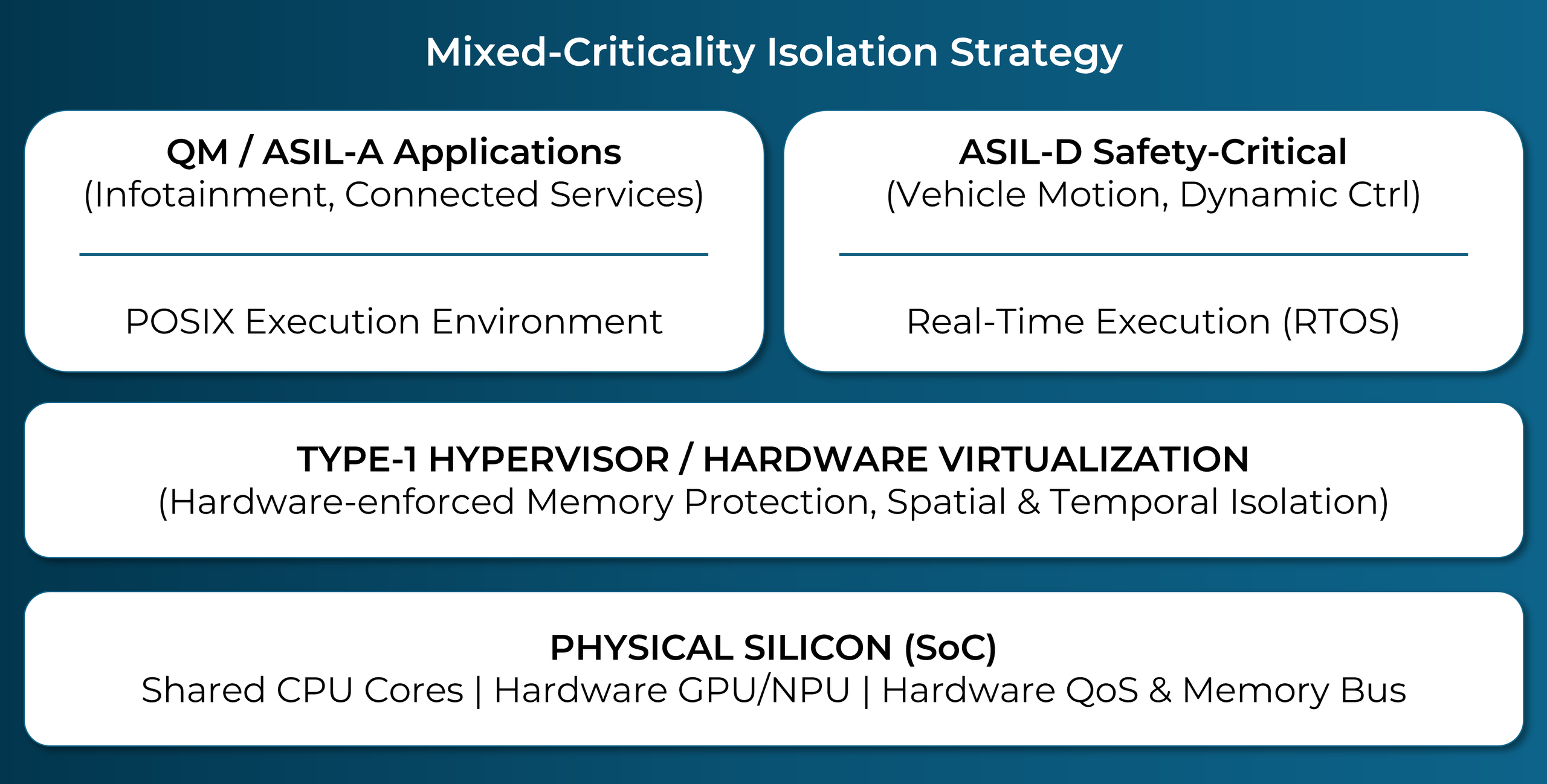
Centralized compute does not eliminate the need for isolation. Instead, it replaces physical separation across dozens of ECUs with controlled isolation mechanisms that allow workloads with vastly different safety and timing requirements to coexist on shared silicon.
Figure 4.4 | How Centralized Compute Preserves Freedom from Interference
Source: LOCKS Technology Consulting
1. Architectural Challenge: The Mixed-Criticality Dilemma
When consolidating cross-domain functions onto a shared System-on-Chip (SoC), software tasks with fundamentally opposing safety, timing, and execution requirements must co-exist:
- ASIL-D Workloads: Require hard, deterministic real-time execution, strictly bounded latency, and provable temporal isolation.
- QM/ASIL-A Workloads: Characterized by high memory throughput, dynamic process creation, complex graphics pipelines, and frequent third-party code updates.
Uncontrolled co-location creates severe resource contention on shared silicon assets — specifically across L3 cache hierarchies, main memory buses (DRAM controllers), and interconnect fabrics. A memory leak or runaway thread in an infotainment application must never be capable of starving a time-critical braking or steering loop.
2. Technical Enablers: Type-1 Hypervisors and Hardware QoS
To guarantee Freedom from Interference as mandated by ISO 26262, centralized compute architectures rely on a multi-layered isolation strategy:
- Bare-Metal (Type-1) Hypervisors: Operating directly on the underlying silicon, Type-1 hypervisors provide strict spatial and temporal partitioning. They partition CPU cores, memory ranges, and peripheral access into isolated virtual machines (VMs) hosting distinct runtime instances.
- Hardware-Assisted Quality of Service (QoS): Modern automotive SoCs incorporate hardware-level memory transaction throttling and cache-allocation technologies (CAT). This ensures that high-priority ASIL-D memory reads/writes bypass queue bottlenecks caused by graphics-heavy QM workloads.
- Hardware Security Modules (HSM): Isolated cryptographic engines manage root-of-trust anchor points, secure boot sequences, and hardware-enforced memory encryption across VM boundaries.
3. Strategic Engineering Takeaway
Centralization does not eliminate the need for separation. Successful HPC architectures combine shared compute resources with clearly defined safety, timing, and security boundaries. While modern hypervisors and hardware QoS mechanisms enable mixed-criticality integration on common silicon, highly safety-critical vehicle control functions often benefit from dedicated execution domains and independent fallback paths. The engineering challenge is therefore not maximizing centralization, but finding the right balance between compute consolidation, functional isolation, and lifecycle manageability.