
Chapter 3
The Scaling Limit – Why Legacy E/E Frameworks Collapse
Executive Summary
The Problem: The incremental model of adding dedicated ECUs for new features has reached a hard physical and logical limit, resulting in well over 100 ECUs in modern high-end vehicles.
The Core Drivers: The architectural collapse is propelled by four dimensions: exponential software integration effort, physical wiring harness limits, risky OTA updates, and unmanageable field variant combinations.
The Portfolio Scaling Paradox: Deploying 100+-ECU topologies across multiple model lines, powertrains, and regional software baselines destroys platform economies of scale through exponential permutation growth.
The Strategic Pitfall: Treating architecture collapse as a localized engineering subdomain rather than a corporate governance challenge.
Strategic Implications: E/E architecture must become a board-level leadership topic, and organizational structures must strictly align with architectural intent to prevent integration failure.
The C-Level Takeaway: Compute consolidation is an economic imperative. Executives must stop treating architecture as an engineering cost center and start governing it as the primary enabler of platform lifecycle value.
Strategic Analysis
Building upon our historical review in Chapter 2 — which traced how distributed topologies and mechanical domain silos shaped three decades of automotive development — we now analyze the tipping points where these historical structures hit their scaling limits.
For over three decades, the automotive industry managed functional growth by adding dedicated Electronic Control Units (ECUs) for each new feature. This incremental approach was highly successful during periods of predictable product cycles and stable, domain-siloed vehicle functions. However, as vehicles evolved into highly networked systems requiring continuous software updates, cloud connectivity, and advanced driver assistance systems (ADAS), this distributed model reached a hard physical and logical scaling limit. Today, high-end vehicles often carry well over 100 independent ECUs. The resulting complexity has turned from a technical challenge into a structural roadblock.
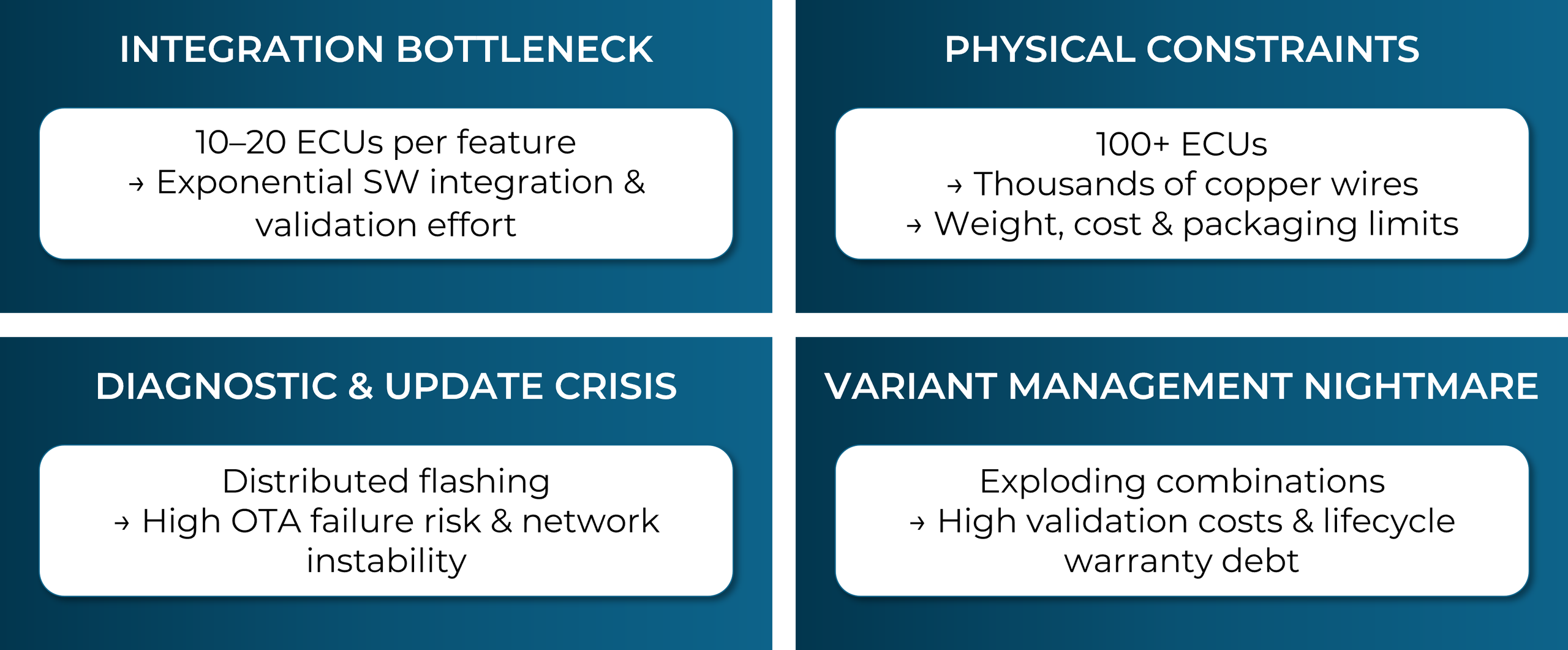
The collapse of the distributed architecture does not happen at a single point; it manifests across four interconnected dimensions that amplify each other:
Figure 3.1 | The Four Dimensions of the Scaling Wall
Source: LOCKS Technology Consulting
- The Integration Bottleneck: When a single new vehicle feature requires functional changes across 10, 15, or 20 separate ECUs sourced from different suppliers, the software integration effort grows exponentially. Testing, validating, and ensuring the functional safety (ISO 26262) and Cybersecurity of these fragmented software states becomes economically and temporally unviable.
- The Physical Constraints: A hundred independent ECUs mean hundreds of localized power supplies, housings, and mounting brackets. More critically, they require thousands of individual copper wires. The vehicle wiring harness has become one of the heaviest, most expensive, and most complex components of the vehicle, pushing packaging space and assembly lines to their absolute limits.
- The Diagnostic and Update Crisis: In a highly distributed network, performing reliable over-the-air (OTA) updates is a high-risk operation. If one flashing process fails or a single timing margin shifts due to a software update, the entire network topology can become unstable.
- The Variant Management Nightmare: With more than 100 ECUs, the number of theoretically possible software and hardware combinations in the field scales non-linearly. Because almost every controller across different trim lines carries its own software variants, verifying, releasing, and securing updates over the lifecycle becomes a financial and logistical nightmare for the OEM, driving warranty and validation costs into the hundreds of millions.
The Portfolio Scaling Paradox
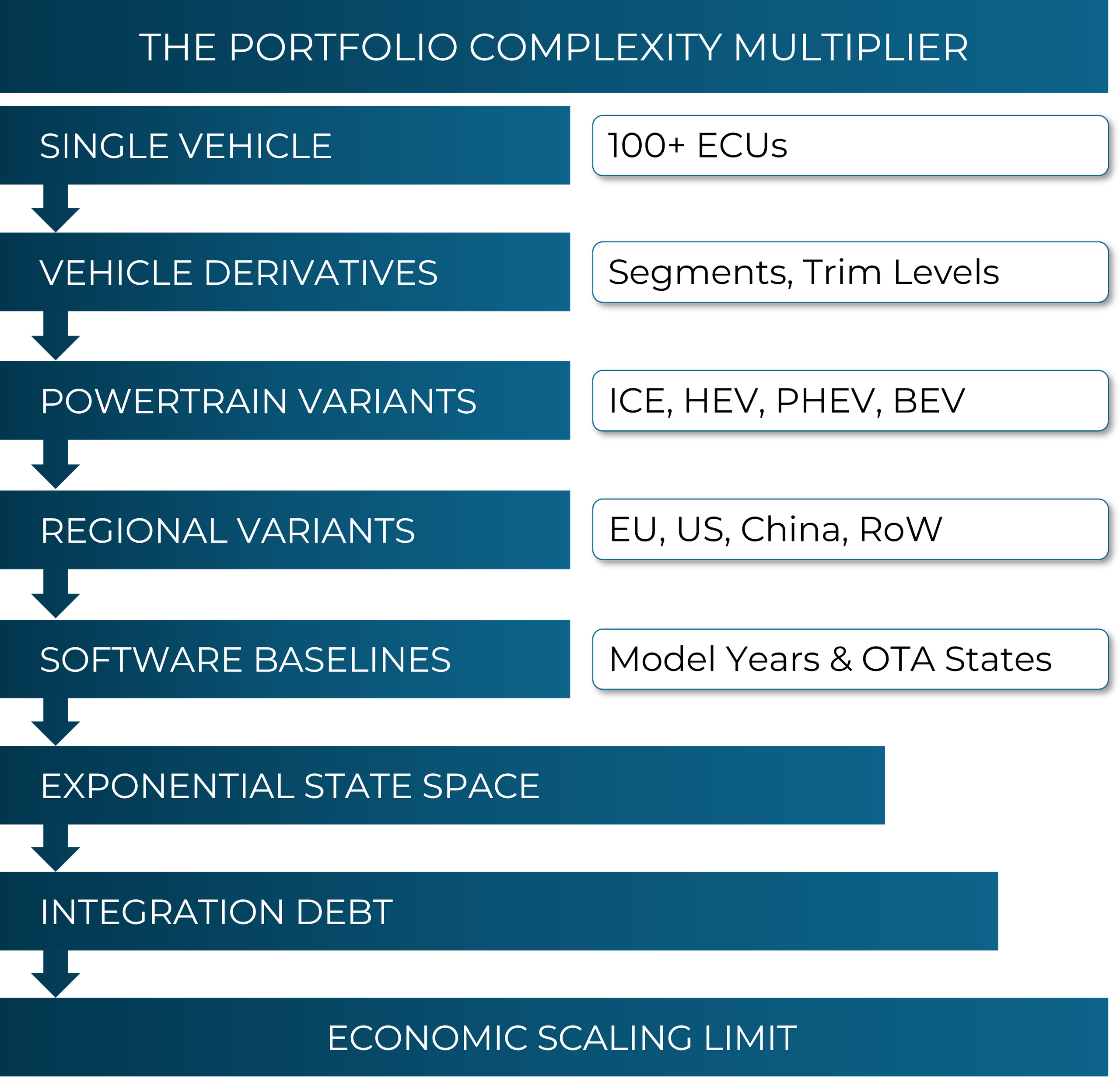
While managing more than 100 ECUs within a single vehicle already represents a significant engineering challenge, the true scaling limit emerges only when this architecture is deployed across an entire OEM portfolio. The architectural crisis is therefore not primarily a vehicle-level problem. It is a portfolio-level problem.
A single vehicle architecture rarely exists in isolation. OEMs must deploy the same architectural foundation across multiple vehicle segments, regional markets, powertrain variants, model years, optional equipment levels, regulatory environments, and software baselines. Each of these dimensions introduces additional variation that must be developed, tested, released, secured, and maintained throughout the product lifecycle.
What appears manageable at the vehicle level becomes exponentially more complex at fleet scale.
Figure 3.2 | The Portfolio Complexity Multiplier
Source: LOCKS Technology Consulting
From Linear Components to Exponential Combinations
The fundamental misconception is that architectural complexity grows linearly with ECU count. In reality, complexity grows with the interactions between components, software versions, suppliers, and vehicle derivatives.
An architecture consisting of 100 ECUs does not create 100 management challenges.
It creates thousands of dependencies:
- ECU-to-ECU communication interfaces
- Software version dependencies
- Supplier-specific implementation variations
- Regional homologation differences
- Powertrain-specific adaptations
- Safety validation combinations
- Cybersecurity compliance states
Each additional derivative increases the possible number of validated system states far faster than engineering capacity can scale.
At a certain threshold, every new vehicle program creates more integration effort than reusable platform value.
The Hidden Shift in Engineering Economics
This creates a dangerous economic inversion.
Historically, platform strategies generated economies of scale:
- More vehicles shared more components.
- More volume reduced development costs.
- More reuse improved profitability.
In highly fragmented ECU architectures, the opposite begins to happen.
Each new derivative requires:
- Dedicated software branches,
- Localized supplier calibrations,
- Separate validation campaigns,
- Additional cybersecurity assessments,
- Unique update qualification paths.
As a result, platform scale no longer reduces complexity. Platform scale amplifies complexity.
The traditional economics of scale gradually turn into the economics of maintenance.
Engineering organizations gradually transition from innovation engines into maintenance organizations. A growing share of R&D resources is consumed by preserving compatibility across existing variants instead of creating new customer value.
Why Executives Should Care
From a board-level perspective, the most important question is no longer:
How many ECUs does the vehicle contain?
The more important question becomes:
How many vehicle variants can the organization economically sustain over the platform lifecycle?
The Point Where Complexity Overtakes Value Creation
The real scaling limit is not reached when a vehicle exceeds 100 ECUs.
It is reached when complexity grows faster than value creation.
At this point:
- Time-to-market deteriorates.
- Validation cycles expand.
- Software release velocity slows.
- Warranty exposure grows.
- Lifecycle maintenance costs accelerate.
- Platform reuse benefits disappear.
The architecture may remain technically functional, but it becomes economically unsustainable.
Once this threshold is crossed, complexity transforms from an engineering issue into a business-model issue.
The portfolio scaling paradox reveals that the true constraint is not compute, wiring, or software alone. The true constraint is organizational capacity to manage architectural complexity across an entire product portfolio.
What initially appears to be a technical integration challenge ultimately becomes a limitation on growth, profitability, and lifecycle competitiveness.
In that sense, architectural complexity is no longer an engineering problem. It has become a balance-sheet problem.
The Common Pitfall: Treating Complexity as a Technical Subdomain
When faced with this scaling wall, OEMs often commit a costly strategic mistake: treating architecture collapse as an isolated engineering problem rather than a corporate governance issue.
Attempting to overcome the scaling wall by adding more software engineers, expanding validation teams, or pursuing incremental optimizations within traditional domain structures merely increases operational overhead without addressing the underlying cause. Because legacy domain silos reinforce and are reinforced by siloed hardware contracts, technical fixes inside the old organizational framework fail to break the vicious cycle. The scaling limit cannot be engineered away; it must be governed away.
The Strategic Implications: From Engineering to Leadership
Recognizing that technical scaling limits are rooted in governance boundaries forces a structural re-evaluation of how vehicles are engineered and led. Overcoming this wall requires a fundamental paradigm shift:
- Architecture becomes a strategic leadership topic: E/E architecture defines the capability ceiling, lifecycle behavior, and cost structure of the entire vehicle platform. It can no longer be delegated as a technical subdomain. For OEMs, this means architecture must be governed at board level, with clear ownership, long-term decision authority, and cross-domain alignment. For Tier-1s, sustainable business growth requires actively shaping architectural evolution — not merely following OEM specifications.
- Organizational models must align with architectural principles: Modern architectures require continuous cross-domain integration across teams, interfaces, suppliers, and lifecycle stages. Legacy organizations optimized for incremental, isolated feature development are obsolete. Without matching organizational structures to architectural intent, execution fails and integration complexity grows exponentially.
Continue Reading → Governance Boundaries, ISO 26262 Safety, and Cybersecurity Trade-Offs explores how distributed architectures amplify safety validation effort, cybersecurity exposure, software variant proliferation, and governance complexity, ultimately transforming architectural scale into a systemic risk.
Bottom-Line & Key Takeaway
The scaling limit is not a signal that the automotive industry is lacking engineering talent; it is proof that the historical framework of building vehicles has run its course. True innovation is no longer limited by what software can do, but by the physical and architectural constraints of its execution environment and how it is governed.
The transition to compute consolidation is not a technical feature upgrade — it is an economic imperative. Executives must stop treating architecture as an engineering cost center and start governing it as the primary enabler of platform lifecycle value.
Key Strategic Insight
“The real scaling limit is reached when complexity grows faster than value creation.”
The Next Logical Step
If the scaling limit cannot be overcome through further ECU distribution, the next question is not whether compute consolidation will happen, but what form of centralized execution environment can scale sustainably.
Chapter 4 explores why centralization is often misunderstood and why the future is not “one big computer”, but a scalable multi-tier compute architecture.
Ready to Overcome the Scaling Wall?
From Systems Complexity to Strategic Clarity.
When complexity grows faster than value creation, architecture becomes a strategic business issue. The key question is no longer whether change is required, but where to start.
Glossary
- ISO 26262: The international standard for functional safety of electrical and/or electronic systems in production automobiles.
- Over-The-Air (OTA): Wireless delivery of software updates, patches, or settings to vehicle control units throughout its lifecycle.
- Variant Management: The discipline of controlling, verifying, and releasing the vast matrix of software and hardware combinations across a vehicle fleet.