
Governance Boundaries, ISO 26262 Safety, and Cybersecurity Trade-Offs
When an E/E architecture scaled to over 100 ECUs, the primary failure mode ceased to be single-component hardware failure. Instead, systemic complexity became the dominant risk factor. To understand why legacy frameworks collapse, engineering leaders must examine how distributed topologies impact functional safety (ISO 26262), cybersecurity compliance (UNECE R155/R156), and corporate governance.
The ISO 26262 Functional Safety Trap in Distributed Topologies
In a distributed architecture, achieving higher Automotive Safety Integrity Levels (ASIL-C or ASIL-D) for cross-domain features (such as automated emergency steering or regenerative braking integration) forces functional safety concepts to span multiple ECUs.
- Cascading Failure Modes: When a safety-critical signal must traverse multiple CAN/LIN buses and intermediate gateways, proving “Freedom from Interference” (FFI) becomes mathematically and operationally complex. Bus latencies, message jitter, and non-deterministic gateway routing delays degrade safety margins.
- Safety Validation Explosion: ISO 26262 requires safety arguments to remain valid across all relevant system configurations. As vehicle portfolios expand, the effort required to maintain safety evidence, perform impact analysis, and verify change propagation increases dramatically. What begins as a safety engineering challenge eventually becomes a portfolio scalability challenge.
Cybersecurity (UNECE R155/R156) & Surface Area Explosion
Legacy bus protocols (Classic CAN, LIN) were designed without native cryptographic authentication, message encryption, or explicit identity verification.
- Expanded Attack Surface: In a network with 100+ entry points, every single ECU represents a potential attack vector. Once an attacker compromises a single low-criticality ECU (e.g., an aftermarket door module or diagnostic port), the lack of internal zero-trust isolation allows unauthorized signal injection across the shared bus.
- Compliance Bottlenecks: Modern regulatory frameworks like UNECE R155 (Cybersecurity Management Systems) and R156 (Software Update Management Systems) mandate end-to-end traceability, vulnerability management, and secure flashing mechanisms. Auditing and securing 100+ independent, non-abstracted software stacks from 30 different suppliers creates an unsustainable operational burden.
The Portfolio Permutation Trap
When distributed E/E topologies are expanded across full product lines, the cross-multiplication of hardware revisions, regional network variations (e.g., EU vs. US vs. China connectivity requirements), and powertrain configurations (ICE, BEV, PHEV) creates an untestable software baseline matrix.
- Branching Overhead: Software teams end up maintaining hundreds of distinct firmware branches for identical functional domains.
- Regression Testing Bottlenecks: A bug fix deployed for one model derivative cannot be directly merged into another due to slight variations in ECU hardware stepping and signal routing, resulting in duplicated engineering cycles and delayed time-to-market.
Strategic Governance Framework: Breaking the Vicious Cycle
Overcoming the scaling limit requires shifting architectural decision-making from departmental domain heads to a centralized platform governance structure.
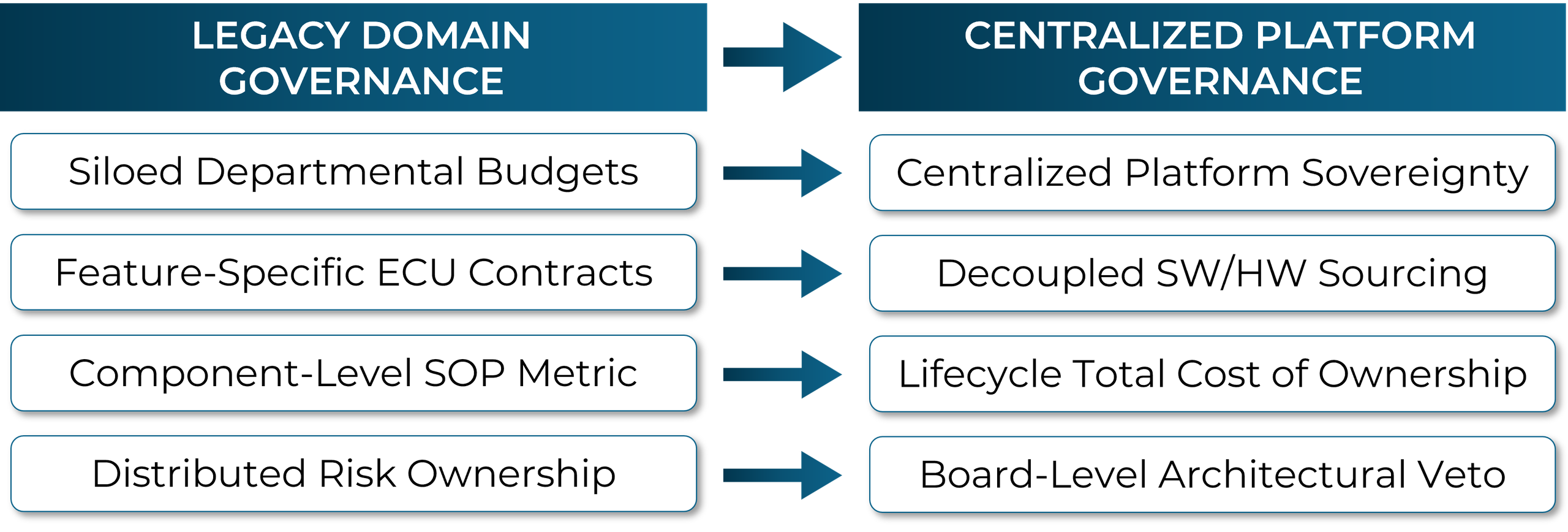
Governance & Architecture Transition
Figure 3.3 | The Governance & Architecture Transition
Source: LOCKS Technology Consulting
- Board-Level Ownership: E/E architecture establishes the capability ceiling and cost structure of the entire vehicle platform. Decisions regarding compute consolidation, network backbones, and abstraction layers must be governed at the board level, with clear veto power over short-term project shortcuts.
- Decoupled Contracting: Procurement models must transition away from sourcing bundled, black-box HW/SW combinations. OEMs must own the system-level interface definitions, API contracts, and integration architecture, allowing hardware to be commoditized while software evolves continuously post-SOP.
- Platform Accountability: Platform ownership must extend beyond SOP delivery. Architectural decisions should be evaluated against lifecycle scalability, software maintainability, cybersecurity exposure, and total cost of ownership across the entire vehicle portfolio.