
Chapter 6
The Software-Defined Vehicle – Architecture Over Labels
Executive Summary
Core Paradigm: Software-Defined Vehicle (SDV) is an internal engineering and organizational capability, not a marketing label or an off-the-shelf product. It shifts vehicle value creation from static SOP delivery to continuous lifecycle value, post-SOP feature enablement, and long-term monetization.
The Technical Pillars: Realizing an SDV requires five foundational pillars: standardized Operating Systems & Middleware, Service-Oriented Architecture (SOA), dynamic Virtualization & Isolation, End-to-End Cybersecurity & UNECE Compliance, and cloud-native CI/CD test pipelines.
Systems Engineering & Interface Discipline: End-to-end Systems Engineering is the non-negotiable prerequisite to control integration complexity. Strict API contracts and unfragmented open middleware standards protect dynamic software environments from destabilizing core safety partitions.
Monetization & Portfolio Scalability: Continuous post-SOP monetization demands robust lifecycle infrastructure. Unadulterated software standards allow OEMs to scale a single, unified software baseline horizontally across complex, multi-segment vehicle portfolios (ICE, PHEV, BEV) without spawning costly, model-specific software derivatives.
Organizational Integration Sovereignty: OEMs cannot outsource core integration competence while claiming software leadership. Platform success requires reclaiming internal authority over system boundaries, middleware abstraction, and cloud-hosted virtual target (vECU) release gatekeeping.
Beyond the Marketing Hype: Defining the SDV Execution Paradigm
As established in Chapter 5, zonal architectures solve the physical and mechatronic bottlenecks of vehicle cabling, providing localized power distribution and signal translation. However, physical topology optimization alone does not deliver a Software-Defined Vehicle.
The industry term “Software-Defined Vehicle” has been widely diluted by marketing campaigns promising smartphone-like feature updates, over-the-air (OTA) app stores, and rapid subscription models. Beneath this commercial veneer, an SDV represents a fundamental transformation in how vehicle functionality is developed, validated, deployed, and monetized across the full operational lifecycle.
Technically, an SDV means that the vehicle’s features, user experience, and dynamic operational profiles are primarily defined by software rather than being locked into physical hardware components at Start of Production (SOP). This transition requires establishing five technical pillars:
- Operating Systems and Middleware: Standardized runtime environments (AUTOSAR Adaptive, POSIX, SOAFEE) that abstract complex silicon topologies, enforce execution isolation, and provide predictable APIs.
- Service-Oriented Architecture (SOA): Transitioning from static, signal-based bus matrices (CAN/LIN) to dynamic, discoverable services (SOME/IP, gRPC), decoupling application logic from physical network location.
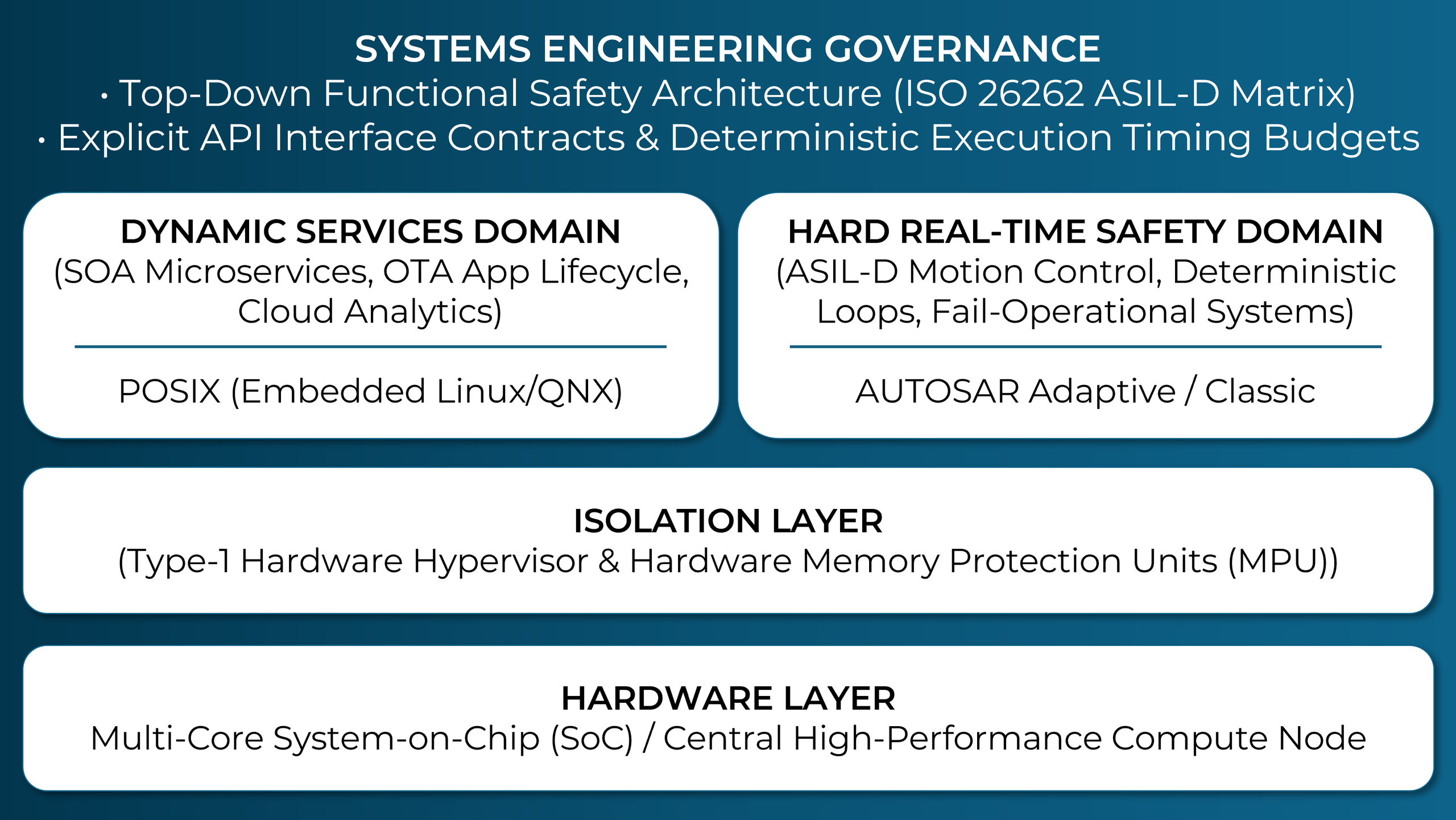
- Virtualization & Spatial/Temporal Isolation: Utilizing Type-1 hypervisors and hardware-enforced memory protection to run dynamic, non-critical workloads alongside deterministic safety kernels on shared silicon without mutual interference.
- End-to-End Cybersecurity & Compliance: Zero-trust security architectures integrating Hardware Security Modules (HSMs), Public Key Infrastructure (PKI), Vehicle Security Operations Centers (vSOC), and strict UNECE R155/R156 regulatory compliance for dynamic code execution.
- Cloud-Native CI/CD & Automated Testing: Automated virtual integration pipelines (vECU) that execute continuous builds, automated regression testing, and fleet-wide OTA deployments without risking vehicle stability.
Continue Reading → How SDV Execution Is Operationalized explores how mixed-criticality runtime environments, middleware abstraction layers, service-oriented architectures, and cloud-native virtual target pipelines transform Software-Defined Vehicle concepts into scalable, lifecycle-ready execution platforms.
Systems Engineering: The Essential Key for Integration Integrity
A critical pitfall in SDV initiatives is attempting to implement dynamic software execution without updating legacy Systems Engineering disciplines. In a traditional distributed architecture, functional integration was physically bounded by individual control units. In a service-oriented, centralized SDV environment, functional boundaries become dynamic and software-defined.
Systems Engineering is the mandatory discipline required to master this integration complexity. It establishes explicit top-down governance over signal-to-service mapping, execution timing budgets, memory allocation bounds, and fail-safe recovery modes before code development begins. Without rigorous Systems Engineering, dynamic software environments inevitably suffer from interface drift, resource contention, and late-stage integration failures during physical validation.
Figure 6.1 | The Governance Stack Behind a Software-Defined Vehicle
Source: LOCKS Technology Consulting
Bridging the Commercial Dilemma: Post-SOP Monetization and Portfolio Scaling
The strategic shift to SDV forces a fundamental realignment of automotive commercial models. Traditional financial frameworks calculate R&D expenditure, piece-cost Bill of Materials (BOM), and profit margins strictly up to the point of SOP. Post-SOP software maintenance was historically viewed as a zero-revenue warranty expense.
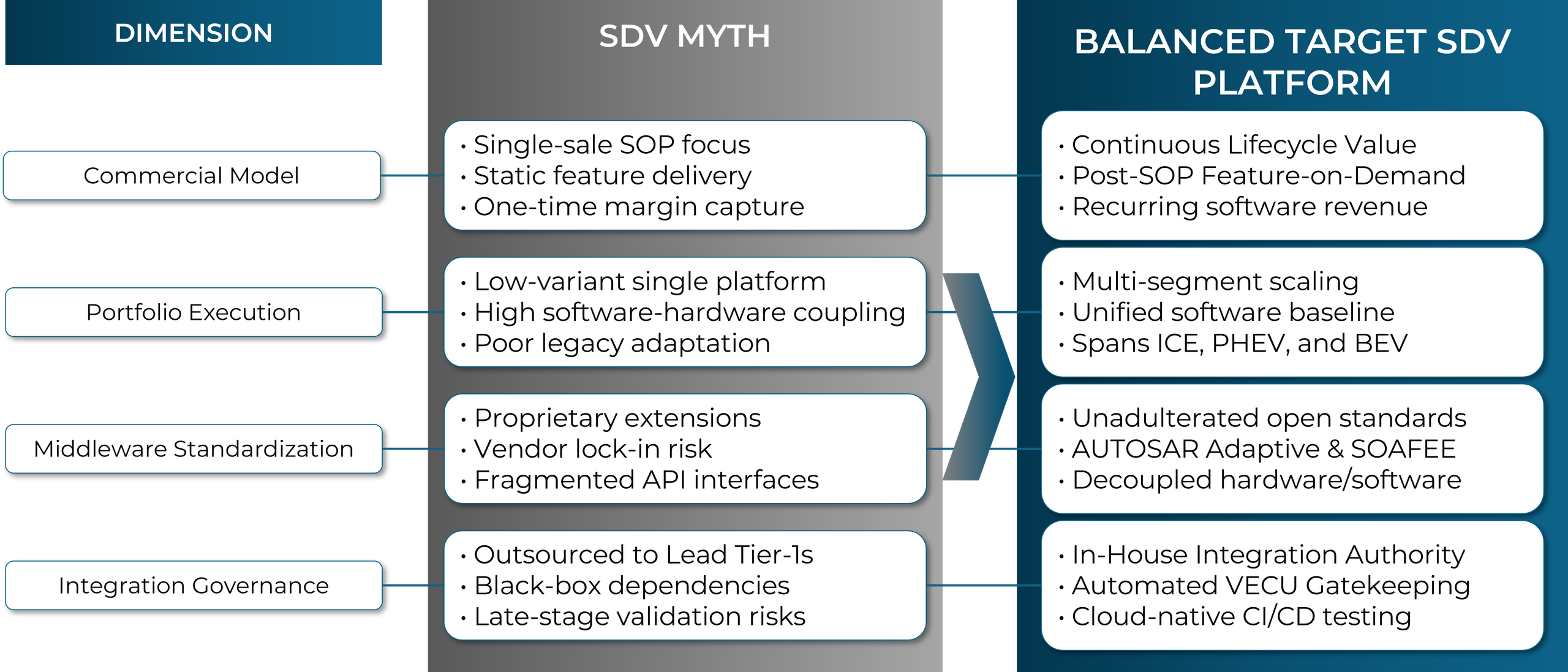
SDV architectures invert this model, shifting the focus to Continuous Lifecycle Value. By decoupling software release cycles from hardware SOP, OEMs can unlock continuous revenue streams post-sale through over-the-air feature upgrades, Features on Demand (FoD), and dynamic performance optimizations. However, realizing this revenue model requires establishing long-term cloud operations, automated verification pipelines, and compliant OTA governance.
Figure 6.2 | From SDV Myth to a Scalable Software Platform
Source: LOCKS Technology Consulting
Furthermore, SDV execution must address Portfolio Scalability. Greenfield EV entrants thrive on low portfolio variance, applying a highly verticalized software stack across a small number of standardized models. Legacy OEMs, by contrast, must support complex global portfolios spanning multiple vehicle segments and powertrain types (ICE, PHEV, BEV).
Forcing a single, rigid software monolith onto a highly customized fleet leads to extreme architectural coupling. To scale efficiently, OEMs must enforce Unadulterated Standardization. Historically, concepts like AUTOSAR Classic suffered because individual OEMs added custom, proprietary extensions, destroying vendor interoperability and creating software fragmentation. In the SDV era, OEMs must strictly adhere to open, unfragmented middleware standards (AUTOSAR Adaptive, SOAFEE) without proprietary add-ons. Clean, standardized abstraction layers isolate hardware variations and allow a core software baseline to scale seamlessly across diverse portfolio derivatives.
Bottom-Line & Key Takeaway
A Software-Defined Vehicle is a systemic operational capability, not a product label or an off-the-shelf software bundle. Executive success requires translating SDV marketing hype into boardroom strategy: building internal integration sovereignty, implementing top-down Systems Engineering, enforcing unadulterated middleware standards, and realigning business models to capture continuous post-SOP lifecycle value across the entire vehicle portfolio.
Key Strategic Insight
“A Software-Defined Vehicle is not a product architecture. It is an organizational capability.”
The Next Logical Step
Having established the structural pillars, middleware abstractions, and governance frameworks of the Software-Defined Vehicle, we must now address the next frontier of vehicle compute: evaluating how probabilistic Artificial Intelligence models can be safely integrated into deterministic, safety-critical vehicle software architectures.
Ready to Operationalize the SDV?
From Systems Complexity to Strategic Clarity.
A Software-Defined Vehicle is not a product feature. It is an organizational capability built on architecture, software platforms, and lifecycle execution.
Glossary
- API (Application Programming Interface): A standardized set of routines, protocols, and tools for building software applications, enforcing stable interface contracts between distinct software layers.
- CI/CD (Continuous Integration / Continuous Deployment): An automated operational methodology enabling software updates to be continuously built, tested, validated, and deployed into vehicle fleets via OTA.
- Features-on-Demand (FoD): A commercial capability allowing vehicle owners to unlock or subscribe to post-SOP software features, hardware capabilities, or performance enhancements via over-the-air updates.
- SOA (Service-Oriented Architecture): A software design paradigm where vehicle functions are structured as discoverable, loosely coupled microservices communicating via standardized protocols over high-speed networks.
- SOAFEE (Scalable Open Architecture for Embedded Edge): An open-source, cloud-native automotive software architecture framework designed to standardize edge compute abstractions and deployment pipelines.
- UNECE R155 / R156: International UN regulations mandating legal requirements for automotive Cybersecurity Management Systems (CSMS / R155) and Software Update Management Systems (SUMS / R156).