
Operationalizing the Software-Defined Vehicle
The five technical pillars introduced in Chapter 6 form the conceptual foundation of the Software-Defined Vehicle. Implementing them in practice requires a layered execution model that separates software evolution from hardware evolution, abstracts functional capabilities from physical implementation, and enables continuous lifecycle deployment.
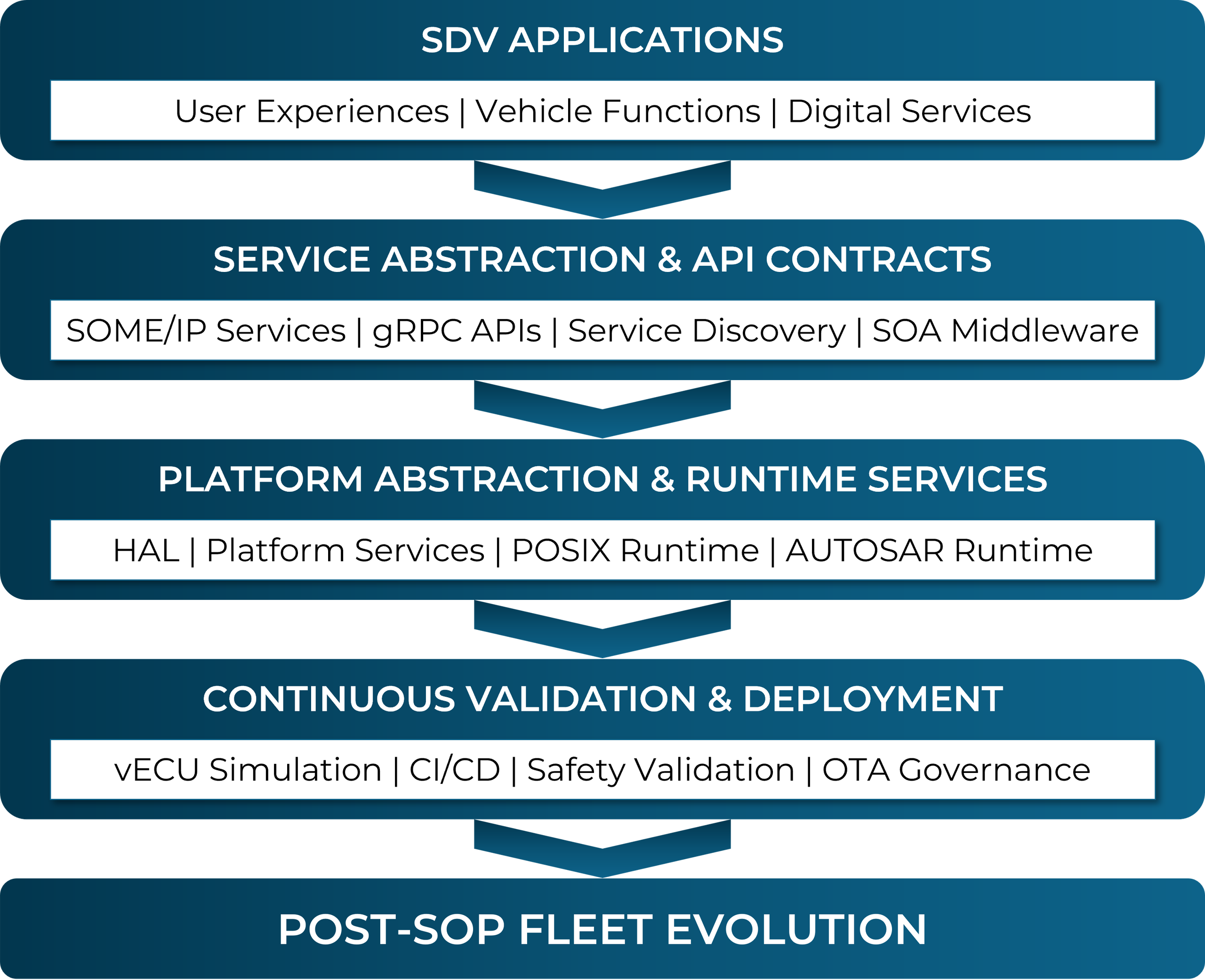
The following execution architecture illustrates how Software-Defined Vehicles operationalize software abstraction, service-based integration, and continuous deployment across the vehicle lifecycle.
Figure 6.3 | The SDV Execution Architecture
Source: LOCKS Technology Consulting
Service Abstraction & API Contracts
Core Question
How do applications become independent from physical vehicle topology and hardware implementations?
Historically, vehicle functions interacted through fixed signals exchanged between dedicated ECUs. Software-Defined Vehicles replace this model through Service-Oriented Architectures (SOA), enabling applications to consume services rather than individual network signals.
Signal-to-Service Transformation
Legacy vehicle data still originates from physical sensors, actuators, CAN / CAN-FD, and LIN networks. However, instead of exposing raw network signals directly to applications, modern middleware translates them into standardized software services using Service-Oriented Archiectures like SOMEIP, gRPC, and service discovery mechanisms. Consequently, applications consume higher-level abstractions such as vehicle speed services, battery state services, occupancy services, and location services rather than parsing individual low-level network messages.
API Contracts & Service Independence
By introducing stable service interfaces and strict API contracts, software developers no longer need awareness of physical vehicle topology or complex communication routing paths. Applications depend exclusively on defined service contracts.
This structural transformation establishes true software portability, dramatically improves code reuse across diverse vehicle portfolios, and allows software functionality to evolve completely independently from underlying hardware design decisions.
Platform Abstraction & Runtime Services
Core Question
How do software lifecycles become independent from hardware lifecycles?
Software-Defined Vehicles introduce multiple robust abstraction layers between applications and physical hardware, allowing software to evolve across multiple silicon generations while preserving absolute interface stability.
Hardware Abstraction Layer (HAL)
The Hardware Abstraction Layer (HAL) separates application software from silicon-specific implementations by encapsulating peripheral drivers, communication controllers, analog and digital interfaces, and semiconductor-specific hardware registers. Applications interact exclusively through standardized interfaces rather than directly accessing hardware resources.
Runtime Environments and OS Services
Complementing the HAL, advanced runtime environments such as:
- POSIX-compliant environments (including embedded Linux, QNX, and SOAFEE initiatives) providing dynamic execution models required for high-performance computing, connectivity, infotainment, and cloud-facing software services.
- AUTOSAR Adaptive and Classic environments for deterministic execution for safety-critical vehicle functions.
Are enabling fundamentally different software evolution cycles to coexist on a common vehicle platform and not simply isolate execution on the same SoC.
Continuous Validation & Deployment
Core Question
How can automotive-grade safety and cybersecurity be maintained while deploying code at consumer-tech velocities?
Unlike traditional milestone-driven vehicle programs, SDVs require a lifecycle-oriented validation and deployment model built around virtual targets, automated testing, and fleet-wide release governance.
Virtual ECU (vECU) Environments
Software validation progresses through increasingly realistic virtual targets:
- Level 1 – Application vECU: Focuses on functional algorithms, API validation, and unit testing.
- Level 2 – System vECU: Validates operating-system interactions and system integration.
- Level 3 – Silicon-Level vECU: Handles processor emulation, hardware register behavior, and performance verification.
This approach significantly reduces dependence on physical hardware availability and enables earlier system integration.
Automated Validation Pipelines
Continuous validation bridges the gap between fast-paced software development and rigorous automotive safety requirements. Automated cloud-native pipelines execute extensive virtual target testing using vECU (Virtual Electronic Control Unit) environments. Before any code touches physical hardware, these pipelines validate functional behavior, check interface compliance, simulate fault injections, and verify real-time resource budgets across distributed software components.
OTA Lifecycle Deployment
Following successful automated validation, release management pipelines govern secure software signing, compliance verification for regulations such as UNECE R156, and orchestrated fleet-wide rollouts. This structured approach ensures that the software lifecycle extends continuously past the Start of Production (SOP), turning the vehicle into an adaptive platform that safely and reliably evolves throughout its operational life.
Strategic Engineering Takeaway
Centralized compute platforms and zonal architectures provide the technological foundation of modern vehicle platforms. A Software-Defined Vehicle emerges only when software can evolve independently from hardware release cycles.
Organizations achieve this by combining standardized abstraction layers, service-oriented software integration, and continuously validated deployment pipelines. Together, these capabilities transform software from a vehicle component into a continuously evolving platform asset and establish the operational foundation for sustainable post-SOP lifecycle value.