
Chapter 8
The Target Architecture Dilemma – Balancing Flexibility and Cost
Executive Summary
The Greenfield Fallacy: Successful vehicle architectures cannot be copied, licensed, or purchased as complete solutions. Without the corresponding software, systems integration, and organizational capabilities, even the most advanced architecture becomes an expensive liability.
System Synthesis over Technology Selection: Modern vehicle platforms emerge from the interaction of compute, software, communication, and power architecture. Optimizing individual technologies in isolation rarely produces an optimal system.
Functional Allocation, Not Maximum Centralization: The objective of a target architecture is not to centralize everything. Platform success depends on assigning responsibilities deliberately across central compute platforms, zonal controllers, and intelligent edge devices.
Target Image A vs. Target Image B: Every OEM must balance architectural ambition against execution capability. Radical centralization maximizes lifecycle flexibility, while evolutionary hybrid architectures reduce transition risk and preserve legacy investments.
Architecture Defines Lifecycle Economics: Harness complexity, software maintainability, validation effort, OTA velocity, and platform reuse are largely determined by architectural choices. Long-term economics are a consequence of architecture, not merely a bill-of-material optimization exercise.
Part I: The Strategic Imperative of Target Architectures
After exploring the evolution of vehicle E/E architectures, the rise of centralized compute platforms, zonal architectures, software-defined vehicles, and AI-driven functionality, a fundamental question remains:
What is the optimal target architecture for the next generation vehicle platform?
The answer is both simple and uncomfortable:
There is no universal target architecture.
One of the most persistent misconceptions in the automotive industry is the belief that successful vehicle architectures can simply be copied from market leaders and transferred into a different organization.
While architectural patterns can be adopted, target architectures are ultimately a reflection of much deeper realities, including business strategy, product portfolio complexity, organizational maturity, software competence, supply-chain structure, and investment priorities.
As discussed throughout this series, architecture is not an isolated engineering exercise. It represents the technical manifestation of strategic business decisions. Consequently, the optimal target architecture for a software-centric premium EV manufacturer may be fundamentally different from the optimal target architecture for an established global OEM managing multiple brands, powertrain technologies, and regional vehicle platforms.
The objective therefore is not to identify a universal blueprint. The objective is to identify the architecture that best aligns technological capabilities with organizational and commercial reality.
The Greenfield Fallacy
The most dangerous mistake organizations can make during transformation programs is assuming that target architectures can be purchased, licensed, or copied as complete solutions.
Architectures do not operate in isolation!
They are deeply interconnected with:
- vehicle packaging concepts
- thermal management strategies
- power distribution topologies
- software development processes
- safety engineering methods
- supplier ecosystems
- organizational structures
A highly centralized architecture developed within a software-native organization may perform exceptionally well inside its original environment while becoming operationally unmanageable when transferred into an organization lacking comparable software integration capabilities.
The result is often a costly mismatch between architectural ambition and execution capability.
The challenge is therefore not defining the most advanced architecture.
The challenge is defining the most advanced architecture an organization can successfully implement, maintain, and evolve across multiple product generations.
The Architectural North Star
Despite this caution, every OEM requires a clearly defined architectural target image.
Without a target architecture, individual platform decisions become localized optimizations. Engineering teams solve immediate problems while unintentionally creating future integration barriers, technology dead ends, and software fragmentation.
A target architecture serves as the platform’s North Star.
However, executive leadership must avoid treating this target image as an immutable ten-year vision.
Vehicle architectures are not static!
They represent a strategic snapshot of technological possibilities at a specific point in time, shaped by:
- semiconductor capabilities
- software platforms
- networking technologies
- safety methodologies
- supply-chain maturity
As these boundary conditions change, the architecture must evolve accordingly. The purpose of a target architecture is therefore not to freeze future decisions.
It is to provide a stable direction while preserving enough flexibility to accommodate future technological shifts.
Part II: The Architectural Building Blocks
Before selecting a specific target architecture, leadership must first understand the structural building blocks that form modern vehicle platforms.
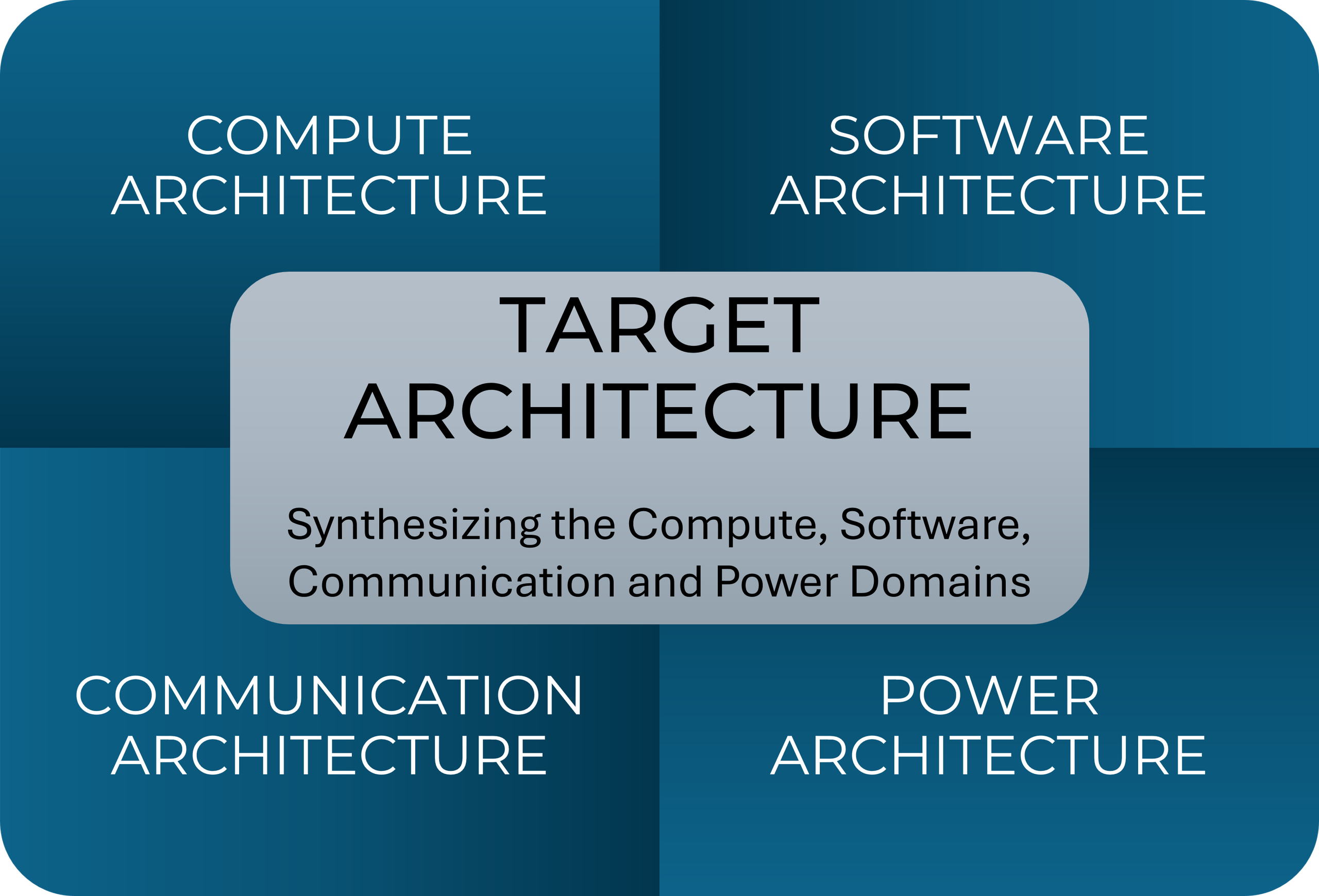
The architectural debate is often reduced to centralization versus distribution. In reality, modern architectures emerge from the interaction of four tightly connected layers:
- Compute Architecture
- Software Architecture
- Communication Architecture
- Power Architecture
Only the combination of all four produces a viable long-term platform.
1. Compute Architecture
The compute layer determines where functions are executed and how workloads are distributed across the vehicle.
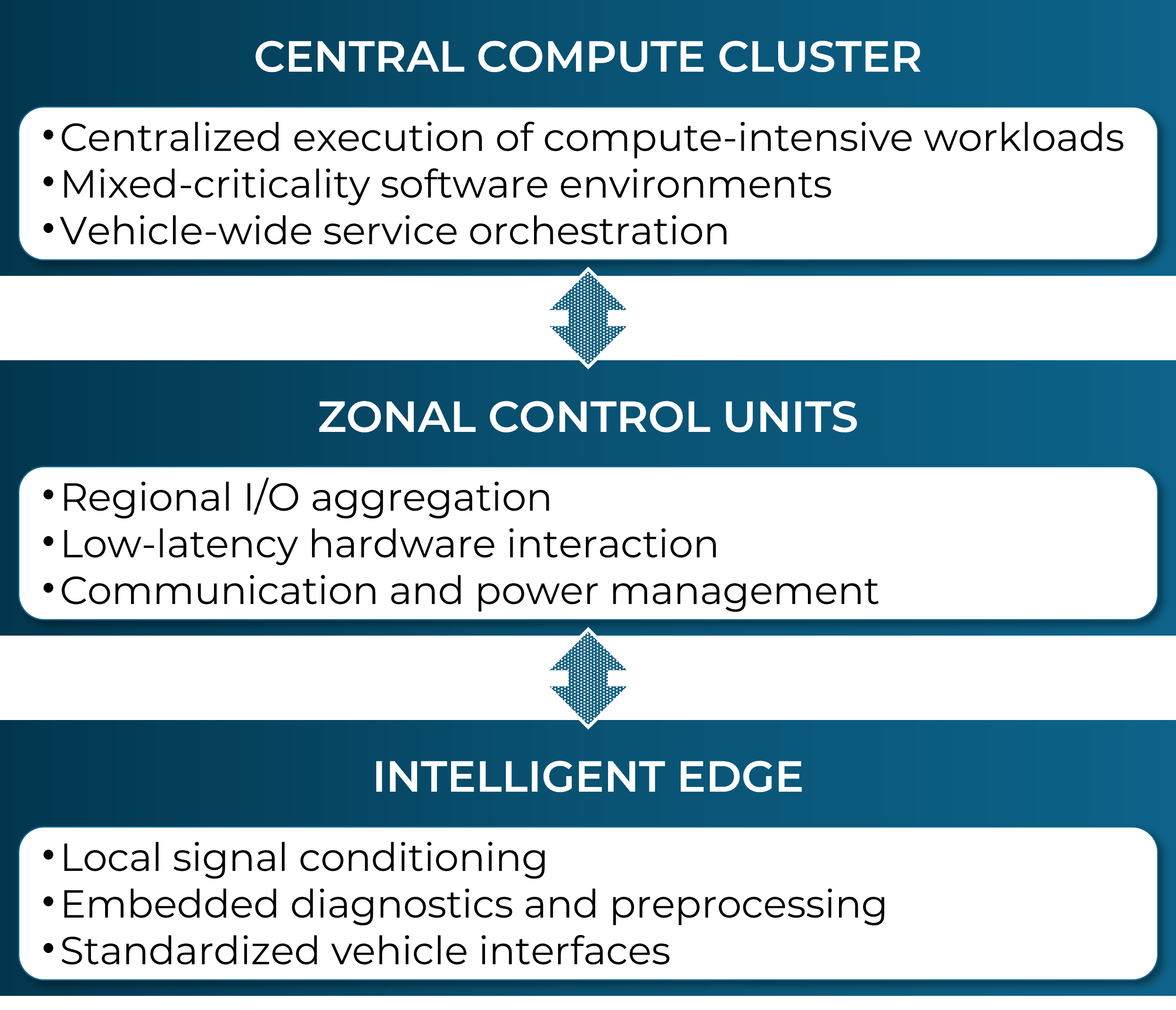
Modern architectures increasingly converge toward a three-tier structure:
Central Compute Platforms
Central compute platforms host the majority of high-level application and coordination functions, especially the highly dynamic and computationally intensive workloads such as:
- ADAS and automated driving
- AI inference
- vehicle motion coordination
- infotainment and digital experiences
- centralized vehicle services
These systems consolidate previously fragmented ECU functionality into a limited number of software-defined compute domains.
Zonal Control Units
Zonal controllers complement the central compute platforms by hosting latency-sensitive and hardware-dependent functions while aggregating sensors, actuators, and communication interfaces within a defined physical vehicle area.
By organizing vehicles around physical zones rather than historical function domains, ZCUs significantly reduce wiring complexity and simplify vehicle integration.
Intelligent Edge Devices
Sensors and actuators increasingly incorporate local intelligence for signal conditioning, diagnostics, and low-latency control functions.
The objective is not the complete centralization of all functionality, but the deliberate allocation of responsibilities across edge devices, zonal controllers, and central compute platforms to optimize performance, scalability, resilience, and cost.
Figure 8.1 | The Simplified Target Architecture Stack
Source: LOCKS Technology Consulting
2. Software Architecture
Compute consolidation only creates value when software can be developed, deployed, and evolved independently from underlying hardware generations.
Modern software architectures therefore rely on layered abstraction concepts.
Mixed-Criticality Execution
Safety-critical control functions and dynamic software applications increasingly share common hardware resources.
This requires robust isolation mechanisms capable of separating:
- safety-certified workloads
- real-time control functions
- infotainment applications
- AI workloads
while maintaining predictable system behavior.
Hardware Abstraction
Middleware layers and standardized software frameworks decouple application logic from hardware implementation details.
This separation enables software reuse, accelerates hardware migrations, and reduces platform-specific development effort across future vehicle generations.
In a software-defined vehicle, software lifecycle management becomes equally important as hardware design.
3. Communication Architecture
As centralized compute platforms increase processing consolidation, communication architectures assume the role of the vehicle’s digital nervous system.
The network must simultaneously support:
- deterministic control traffic
- high-bandwidth sensor streams
- safety-critical communication
- software-defined services
Modern architectures increasingly rely on service-oriented communication frameworks implemented through high-bandwidth networking and compute-interconnect technologies.
High-Speed Vehicle Backbone
Multi-gigabit communication connections provide the bandwidth required for:
- ADAS sensors
- AI workloads
- centralized services
- software updates
Deterministic Communication
Time-sensitive communication mechanisms ensure predictable behavior for real-time and safety-relevant functions operating over shared networks.
Peripheral Connectivity
At the vehicle edge, a combination of different technologies allows architectures to balance performance, complexity, and legacy compatibility.
4. Power Architecture
While discussions often focus on compute and software, power distribution increasingly determines the practical feasibility of future architectures.
The growing electrification of vehicle functions introduces new requirements regarding:
- power delivery
- fault isolation
- redundancy
- operational safety
Multi-Voltage Architectures
Future platforms are expected to combine high-efficiency distribution networks with localized voltage conversion to support diverse component requirements.
Intelligent Power Distribution
Software-controlled power management enables:
- dynamic load control
- fault isolation
- energy optimization
- diagnostic transparency
Fail-Operational Capability
As vehicles become increasingly dependent on software and centralized computation, architectures must tolerate faults without immediately losing critical functionality.
Power distribution therefore becomes an active contributor to vehicle resilience rather than a passive infrastructure service and a fundamental enabler of functional safety concepts, fault isolation, and fail-operational vehicle behavior.
Figure 8.2 | The Target Architecture Synthesis
Source: LOCKS Technology Consulting
Part III: The Target Architecture Spectrum
Once the fundamental building blocks have been defined, organizations must determine how aggressively they wish to pursue architectural centralization.
In practice, most architectures fall between two reference target images.
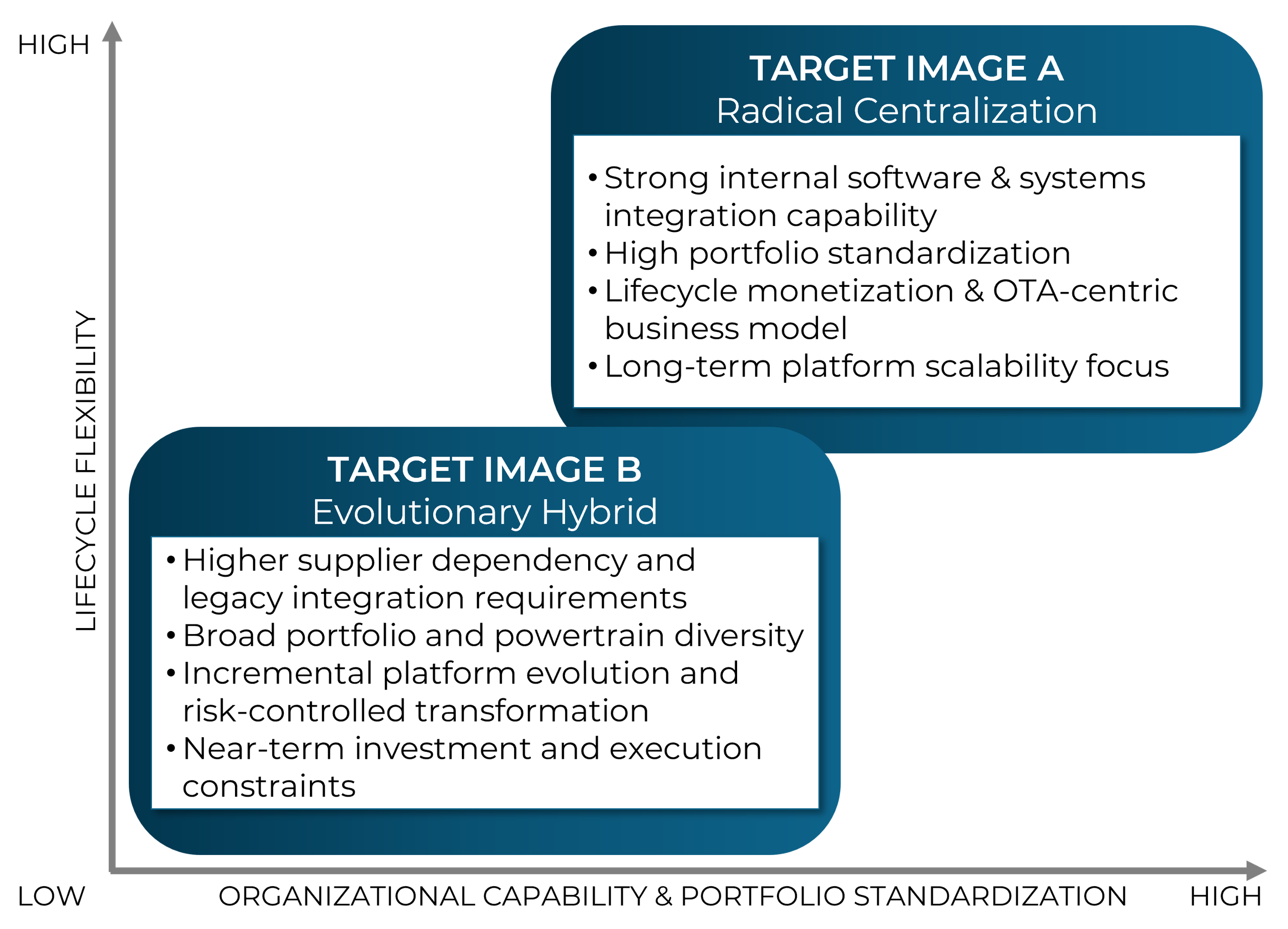
Target Image A: Radical Centralization
The first target image maximizes software flexibility, hardware consolidation, and long-term platform scalability.
Characteristics include:
- 2-3 Central Compute clusters
- lightweight zonal controllers
- high-bandwidth service-oriented communication fabrics
- highly centralized software deployment
- software-controlled power distribution
This approach enables maximum software velocity and minimizes hardware diversity across the platform lifecycle.
However, achieving these benefits requires exceptional software integration capabilities and organizational maturity.
Target Image B: Evolutionary Hybrid Architecture
The second target image prioritizes manageable transformation and controlled organizational risk.
Characteristics include:
- selective compute centralization
- stronger zonal and domain-level intelligence
- coexistence of modern communication fabrics and legacy protocols
- gradual software migration
- mixed-voltage infrastructures
This architecture accepts certain long-term inefficiencies in exchange for lower implementation risk and improved compatibility with existing vehicle programs.
Figure 8.3 | The Executive Architecture Selection Framework
Source: LOCKS Technology Consulting
For many established OEMs, this represents the most realistic transition path toward software-defined vehicles.
Continue Reading → Engineering the Target Architecture explores how function allocation, communication abstraction, functional safety, power distribution, and architectural scalability shape modern vehicle platforms. It examines why successful architectures emerge from balancing centralization and distribution, and how common architectural patterns can scale from entry-level vehicles to premium flagship platforms.
Part IV: The Executive Decision Matrix
The choice between architectural target images is ultimately a strategic decision rather than a purely technical one.
Leadership must evaluate architectural options against four critical factors:
Software Capability
How much software development, integration, validation, and lifecycle ownership can be maintained internally?
Portfolio Complexity
Can a single platform support the organization’s complete product portfolio, or will significant diversity remain unavoidable?
Organizational Readiness
Do engineering structures, development processes, and governance models support highly integrated platform development?
Transformation Risk
How much disruption can ongoing vehicle programs absorb without jeopardizing launch schedules and profitability?
The correct architecture is not necessarily the most advanced.
The correct architecture is the one that can be successfully executed.
Table 8.1 | Executive Decision Matrix
| Decision Criterion | Target Image A (Radical) | Target Image B (Evolutionary) |
|---|---|---|
| In-House Software Capability | High | Moderate |
| Potfolio Diversity | Low | High |
| Supplier Dependency | Low | High |
| Lifecycle Flexibility | High | Moderate |
| Transformation Risk | High | Lower |
| Legacy Reuse | Limited | Strong |
Part V: Economic Consequences of Architectural Decisions
Although architecture should not be driven exclusively by short-term cost targets, architectural choices inevitably carry economic consequences.
Centralization decisions directly influence:
- wiring-harness complexity
- ECU count
- software maintenance effort
- validation activities
- OTA deployment efficiency
- platform reuse potential
Importantly, these economic effects emerge as consequences of architectural decisions rather than primary design inputs.
Organizations that focus exclusively on immediate BOM reductions frequently create larger lifecycle costs through software fragmentation, increased validation effort, and reduced platform scalability.
The true economic value of a target architecture therefore emerges across the complete product lifecycle rather than at SOP.
Bottom-Line & Key Takeaway
A target architecture is neither a fixed blueprint nor a purely technical engineering exercise.
It is a dynamic strategic framework that balances:
- technological opportunity
- organizational capability
- portfolio complexity
- lifecycle economics
at a specific point in time.
The most successful vehicle platforms will not be those pursuing the highest possible degree of centralization, but those aligning architectural ambition with execution capability.
Target architectures should therefore be treated as evolving North Stars: stable enough to guide development, yet flexible enough to adapt as technology, organizations, and market conditions continue to evolve.
Engineering Takeaway
- There is no universal target architecture. Architecture must reflect business strategy, portfolio complexity, and organizational capability.
- Modern vehicle platforms are built upon four interconnected pillars: compute, software, communication, and power architecture.
- Radical centralization and evolutionary hybrid architectures represent two ends of a strategic spectrum rather than competing absolutes.
- The economic impact of architecture emerges over the platform lifecycle, not solely through initial BOM optimization.
- Sustainable platform leadership requires balancing architectural ambition with the organization’s ability to execute and evolve the chosen target image.
Key Strategic Insight
“The best target architecture is not the most advanced one.
It is the one your organization can execute successfully.”
The Next Logical Step
To translate this target architecture vision into reality without disrupting current vehicle production, leadership must chart a structured transition strategy. In Chapter 9: The Migration Path – From Legacy Debt to Target Architecture, we analyze how to resolve the dual-platform burden, align corporate structures with Conway’s Law under a Chief Vehicle Architect, and overhaul legacy procurement models.
Ready to Define Your Target Architecture?
From Systems Complexity to Strategic Clarity.
The most advanced target architecture is not always the right one. Success depends on aligning technical ambition with organizational capability and business objectives.
Glossary
- Target Architecture: A strategic architectural vision defining how compute, software, communication, and power domains interact to support current and future vehicle platform requirements.
- Target Image: A specific realization of a target architecture reflecting an OEM’s organizational capabilities, portfolio strategy, and technology choices.
- Architectural North Star: A long-term architectural direction that guides platform decisions while remaining adaptable to future technological and organizational changes.
- Radical Centralization (Target Image A): A target architecture emphasizing maximum compute consolidation, software flexibility, and lifecycle scalability through a small number of central compute platforms and lightweight zonal controllers.
- Evolutionary Hybrid Architecture (Target Image B): A pragmatic target architecture balancing centralization with legacy integration, supplier reuse, and controlled transformation risk.
- Functional Allocation: The deliberate distribution of functions across central compute platforms, zonal controllers, and intelligent edge devices to optimize performance, scalability, resilience, and cost.
- Greenfield Fallacy: The misconception that successful vehicle architectures can be copied, licensed, or purchased without the corresponding organizational, software, and systems integration capabilities.