
Engineering the Target Architecture
Introduction: Architecture Is an Optimization Problem
Target architectures are frequently presented as fixed blueprints. In reality, they represent a series of engineering trade-offs balancing performance, latency, safety, scalability, power consumption, software maintainability, and lifecycle flexibility.
While Chapter 8 introduced the strategic considerations behind target architecture selection, this deep dive focuses on the technical decisions that determine how functions are distributed across compute platforms, zonal controllers, communication networks, and power distribution systems.
The objective is not maximum centralization or maximum distribution. The objective is finding the architectural equilibrium that best balances today’s requirements with tomorrow’s evolution.
Part I: Function Allocation Defines the Architecture
The most important architectural decision is not the selection of the processor, operating system, or communication protocol.
The defining architectural question is considerably simpler:
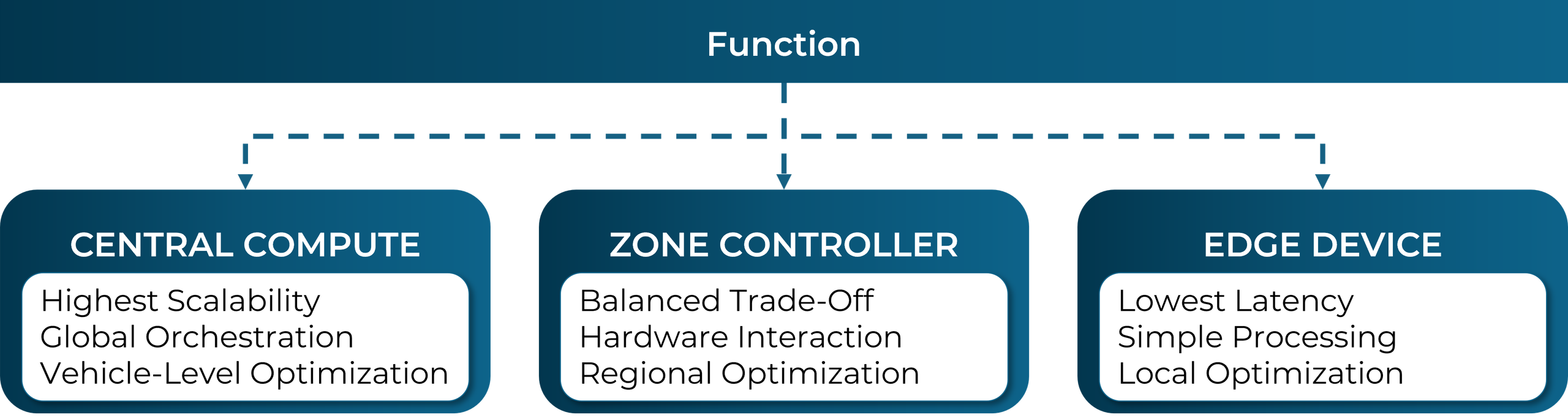
Where should a function execute?
Every architectural decision ultimately comes down to function allocation.
Whether a workload is executed in a central compute platform, a zonal controller, or an intelligent edge device directly influences latency, communication requirements, safety complexity, hardware cost, validation effort, and future software flexibility.
In modern architectures, central compute platforms increasingly host computationally intensive and highly dynamic workloads such as ADAS perception, sensor fusion, AI inference, vehicle coordination functions, and digital cockpit applications. The primary benefit is architectural leverage. Software becomes increasingly independent from the physical vehicle structure and can evolve more freely across vehicle generations.
However, centralization creates new dependencies. Every function moved into a central compute platform becomes dependent on communication paths, bandwidth availability, synchronization mechanisms, and overall system integration quality.
The opposite extreme is equally problematic. Keeping functionality distributed across numerous local controllers minimizes communication dependencies but reintroduces the architectural fragmentation that software-defined platforms are attempting to eliminate.
The challenge is therefore not deciding between centralization and distribution. The challenge is determining the optimal allocation of responsibilities across all layers of the architecture.
Figure 8.4 | The Function Allcoation Framework
Source: LOCKS Technology Consulting
Function allocation is the defining activity of modern target architecture design. The objective is not maximizing centralization, but assigning each function to the architectural layer offering the best trade-off between latency, complexity, scalability, and lifecycle flexibility.
Part II: The Latency-Centralization Trade-Off
One of the most common misconceptions surrounding software-defined architectures is the assumption that centralization automatically produces a better system.
In reality, every centralized function introduces a new dependency chain.
A sensor signal must be captured, transmitted through the vehicle network, processed by a central compute platform, and returned to the actuator. Each step adds latency and increases dependency on network availability.
For many workloads this additional latency is largely irrelevant. Infotainment services, cloud synchronization, over-the-air updates, and many AI-enabled applications operate comfortably within these constraints.
Other functions are considerably more sensitive.
Closed-loop control systems, vehicle dynamics functions, and certain low-level actuator interactions often benefit from remaining closer to the hardware because communication delays can become part of the control-loop behaviour itself.
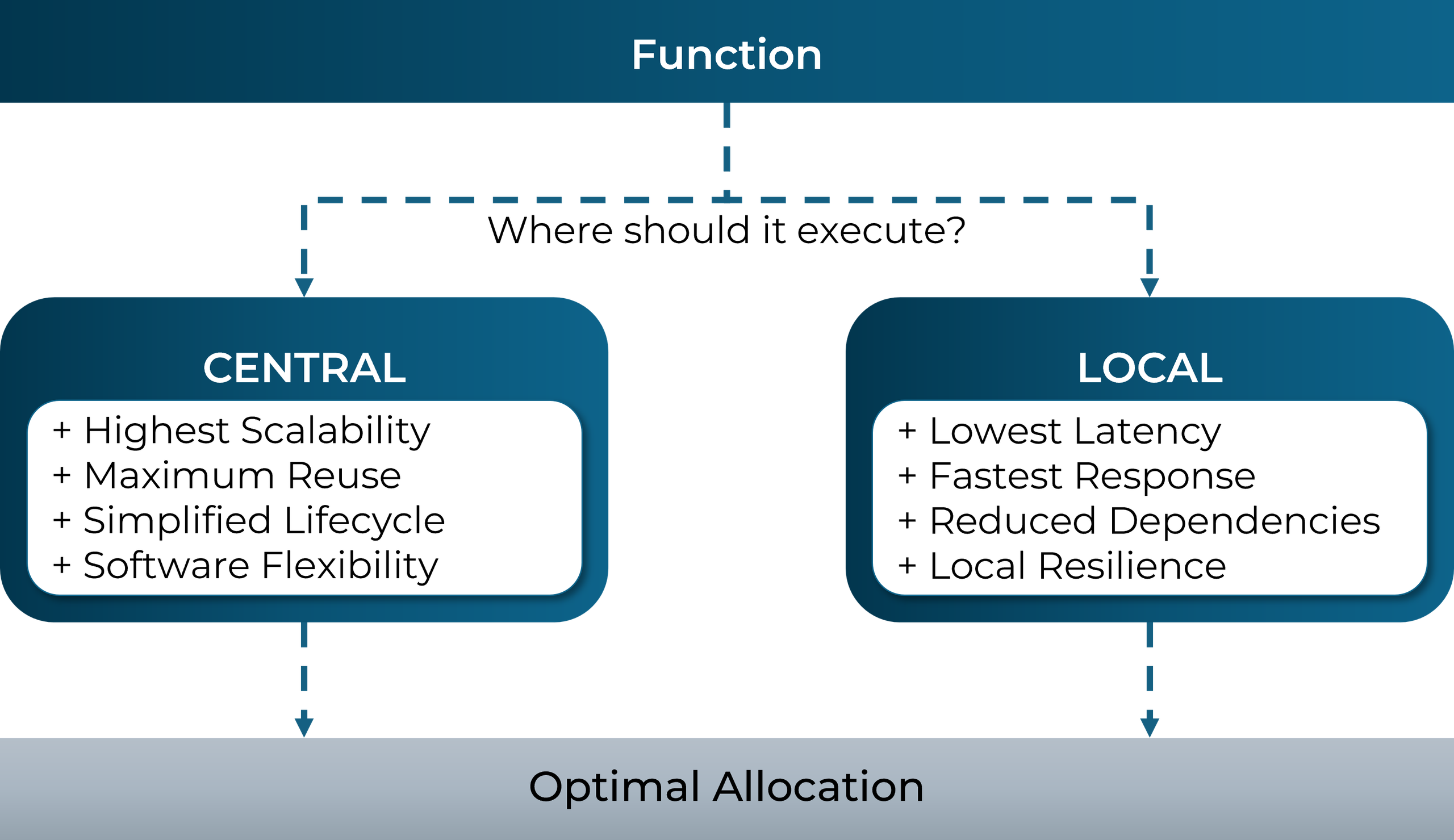
This creates a fundamental architectural trade-off. Centralization improves software flexibility and lifecycle scalability. Local execution improves responsiveness and reduces network dependency.
Successful target architectures balance both perspectives rather than fully embracing either extreme.
Figure 8.5 | The Function Placement Trade-Off
Source: LOCKS Technology Consulting
Part III: Communication Architecture Beyond Bandwidth
Vehicle networking discussions are often reduced to transmission technologies and bandwidth figures. While important, these considerations increasingly miss the architectural point.
The fundamental shift occurring in modern vehicle platforms is not the adoption of Ethernet itself. The real transformation is the transition toward service-oriented communication.
Historically, vehicle communication was tightly coupled to specific networks and physical interfaces. Applications often depended directly on signal definitions, bus structures, and hardware-specific communication paths. This created rigid system boundaries and limited platform scalability.
Software-defined architectures fundamentally change this relationship.
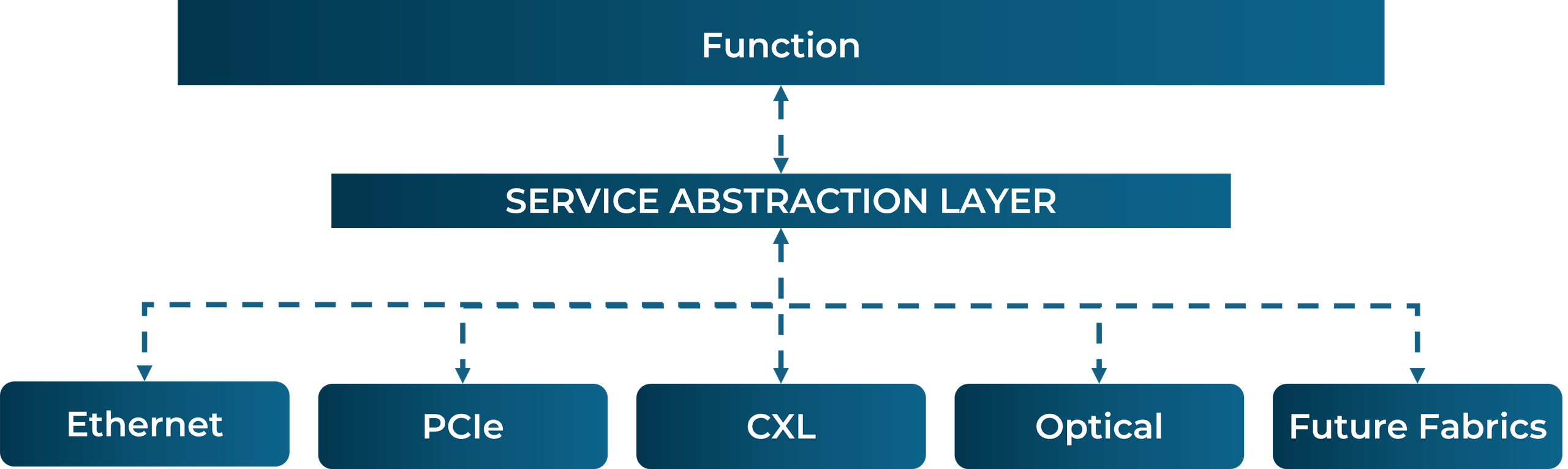
Applications increasingly interact through standardized service interfaces and communication abstractions, allowing the underlying transport technologies to evolve independently of the software layer.
Today’s implementations frequently rely on Ethernet-based backbones, but Ethernet should be viewed as an enabler rather than the architectural objective. High-performance interconnects such as PCIe already play a critical role inside centralized compute platforms, while future technologies may introduce additional communication paradigms.
The architectural goal is therefore not protocol standardization for its own sake. The goal is establishing a communication framework capable of supporting scalable software deployment, deterministic control traffic, distributed computing, and future technology evolution without fundamental architectural redesign.
The most successful target architectures will not be defined by a specific communication technology, but by their ability to absorb future communication technologies without disrupting the software and systems architecture built on top of them.
Figure 8.6 | Decoupling Software from Communication Technologies
Source: LOCKS Technology Consulting
Communication technologies evolve. The architectural pattern remains.
Part IV: Power Architecture as a System Constraint
Power architecture is often viewed as supporting infrastructure. In future software-defined vehicles, it increasingly becomes a critical contributor to system resilience and functional safety.
As vehicle functions become dependent on centralized compute resources, software-defined services, and by-wire technologies, failures can no longer be evaluated solely at component level. The electrical architecture itself becomes part of the overall safety concept.
This fundamentally changes the role of power distribution.
Historically, vehicle power systems focused primarily on energy delivery and circuit protection. Future architectures must additionally support fault isolation, graceful degradation, redundancy management, and fail-operational behaviour.
The electrical network evolves from passive infrastructure into an active system architecture element.
Functional Safety as an Architectural Driver
One of the defining characteristics of modern target architectures is the growing interaction between system architecture and functional safety architecture.
Higher levels of centralization increase the need for careful analysis of:
- ASIL allocation
- freedom from interference
- redundancy concepts
- fail-operational strategies
- safety partitioning
The objective is not necessarily maximum redundancy.
The objective is implementing the minimum amount of redundancy required to achieve system-level safety goals without creating excessive complexity and cost.
Consequently, safety architecture becomes a primary input to target architecture design rather than a validation activity performed afterward.
The Evolution of Power Protection
The transition from mechanical relays and thermal fuses to semiconductor-based protection devices significantly expands architectural possibilities.
Modern intelligent power distribution units increasingly provide capabilities such as:
- software-configurable power paths
- current monitoring
- predictive diagnostics
- high-speed fault isolation
- load prioritization
This creates the foundation for more adaptive and resilient vehicle architectures.
From eFuses to Software-Defined Power Distribution
Current architectures primarily rely on semiconductor-based eFuses utilizing advanced MOSFET technologies.
Future developments are expected to increasingly leverage Wide-Bandgap semiconductor technologies such as Gallium Nitride (GaN) and Silicon Carbide (SiC), enabling higher switching frequencies, lower losses, improved thermal behavior, and greater levels of integration.
Combined with centralized diagnostics and software-controlled power management, these technologies gradually transform power distribution into a programmable platform service rather than a fixed electrical infrastructure.
The result is not only improved efficiency but also greater architectural flexibility for future fail-operational vehicle platforms.
Part V: Architectural Patterns vs. Architectural Variants
One of the most underestimated challenges in target architecture development is platform scalability.
Historically, OEMs frequently deployed different E/E architectures across vehicle segments. Small vehicles, family vehicles, premium vehicles, and performance vehicles often evolved with independent architectural solutions optimized for their specific requirements.
From an engineering perspective, this approach appears logical.
From a lifecycle perspective, it becomes increasingly problematic.
Every additional architecture introduces new software branches, validation activities, safety assessments, cybersecurity artefacts, integration efforts, and lifecycle maintenance costs. Complexity grows significantly faster than the vehicle portfolio itself.
This is where the concept of an architectural pattern becomes critical.
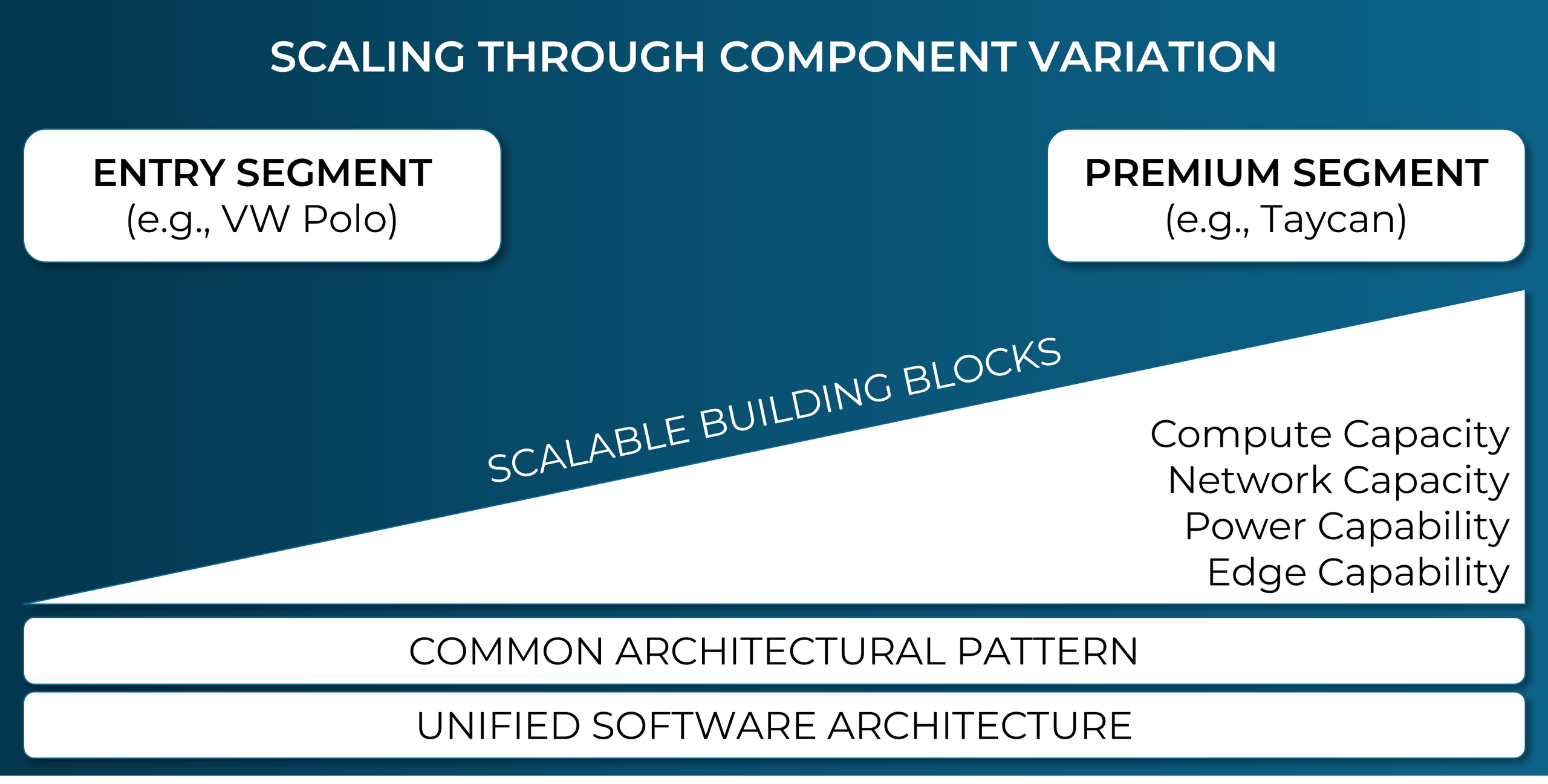
The objective of a modern target architecture is not to create separate architectures for a compact city vehicle and a premium flagship vehicle. The objective is to establish a common architectural pattern that remains valid across the entire portfolio.
The architecture should scale through component variation, not architectural variation.
The Polo-to-Taycan Challenge
A common architectural pattern must support vehicles with fundamentally different requirements.
At one end of the spectrum sits an entry-level vehicle focused on cost efficiency, moderate compute performance, limited sensor configurations, and basic feature content.
At the opposite end sits a premium flagship platform requiring extensive AI acceleration, advanced sensor suites, software-defined functionality, high-bandwidth communication, and sophisticated vehicle dynamics control.
The challenge is not whether a common architecture can support both vehicles.
The challenge is whether it can support both economically.
A scalable architectural pattern therefore keeps the structural principles identical while allowing individual components to scale according to vehicle requirements.
The compute architecture may remain unchanged while processor performance scales.
The communication architecture may remain unchanged while bandwidth scales.
The software architecture may remain unchanged while feature content scales.
The power architecture may remain unchanged while power capability scales.
The objective is architectural consistency combined with component scalability.
This dramatically improves software reuse, platform maintainability, validation efficiency, and long-term lifecycle economics.
Ultimately, the true value of a target architecture emerges when the same architectural principles can successfully support the entire portfolio.
Figure 8.7 | Scaling Through Component Variation
Source: LOCKS Technology Consulting
Portfolio scalability is achieved through component variation, not architectural variation.
Part VI: The Real Cost of Architectural Flexibility
Architectural flexibility is often portrayed as a free benefit of centralization and software-defined platforms.
In reality, every additional degree of flexibility introduces complexity elsewhere in the system.
Centralized architectures simplify lifecycle maintenance and reduce software fragmentation. They enable higher reuse rates, faster deployment cycles, and improved platform scalability.
At the same time, they significantly increase integration complexity, system dependencies, and initial validation effort.
The architecture becomes simpler to operate throughout its lifecycle while becoming more difficult to create.
Hybrid architectures present the opposite trade-off.
They reduce immediate transformation risk and preserve compatibility with existing organizations, suppliers, and vehicle programs. However, they often retain protocol translation layers, duplicated functionality, legacy interfaces, and long-term architectural debt.
The cost is not removed.
The cost is merely paid at a different point in time.
This is why target architectures ultimately represent engineering optimization problems rather than technology selection exercises.
The question is never whether complexity exists.
The question is where the organization is willing and able to manage it.
Engineering Takeaway
- Function allocation is the defining activity of target architecture design.
The primary architectural question is not which technology to deploy, but where individual functions should execute across central compute platforms, zonal controllers, and intelligent edge devices. - The objective is not maximum centralization.
Successful architectures balance centralization and distribution to optimize performance, latency, safety, scalability, resilience, and lifecycle flexibility. - Communication architecture is fundamentally an abstraction challenge.
Service-oriented communication decouples software from underlying transport technologies, allowing communication infrastructures to evolve without redesigning the complete software architecture. - Functional safety must be designed into the architecture from the beginning.
ASIL allocation, partitioning, redundancy concepts, fail-operational strategies, and power-domain design increasingly influence architectural decisions rather than simply validating them afterward. - Power architecture is evolving from passive infrastructure into a software-managed platform capability.
Intelligent power distribution, eFuses, and future Wide-Bandgap semiconductor technologies enable new levels of fault isolation, diagnostics, resilience, and architectural flexibility. - Long-term platform success depends on architectural consistency rather than architectural proliferation.
A common architectural pattern should remain stable across the portfolio while compute, communication, software, and power capabilities scale according to vehicle requirements. - The architecture should scale through component variation, not architectural variation.
A platform that supports both entry-level and flagship vehicles through scalable building blocks creates significantly greater software reuse, validation efficiency, and lifecycle leverage. - The most successful target architectures optimize the complete vehicle system rather than individual domains.
Architecture emerges from balancing compute, software, communication, power, safety, organizational capability, and economic reality as a coherent whole.