
Chapter 2
The Historical Legacy – How We Built the Architecture of Today
Executive Summary
The Context: Distributed E/E architectures originated in the 1980s as pragmatic, isolated solutions for specific mechanical functions.
The Drivers: The distributed ECU-centric architecture model remained viable for more than three decades due to low hardware piece costs, domain-oriented OEM structures, and Tier-1 supplier ecosystems optimized for turnkey SOP delivery.
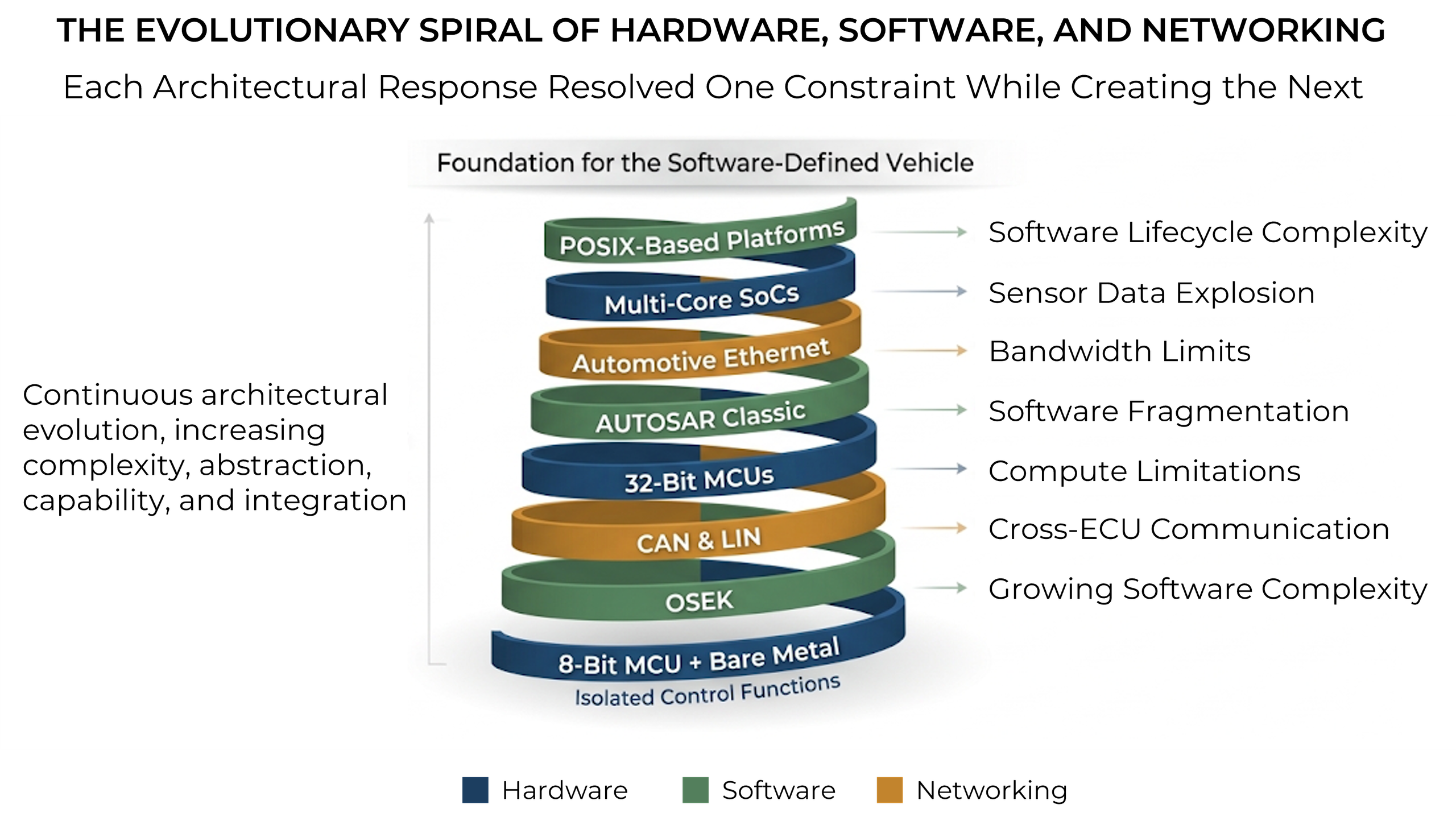
The Technical Spiral: Evolution occurred across three interdependent dimensions: Hardware (8-bit MCUs to multi-core SoCs), Software (Bare-metal to OSEK, AUTOSAR, and POSIX OS), and Networking (CAN/LIN to Automotive Ethernet).
The Strategic Shift: The distributed topology delivered strong fault isolation and departmental autonomy, but created severe cross-domain integration bottlenecks, unmanageable wiring complexity, an inability to support dynamic post-SOP software updates, and a structural barrier to new digital business models.
The Architecture of Pragmatism
In Chapter 1, we examined why modern business expectations increasingly exceed the capabilities of legacy E/E architectures, turning architecture into a primary determinant of competitiveness, innovation velocity, and lifecycle value. To understand why modern automotive transformations are so painful — and how the historical evolution of E/E architecture created the exact structures that now limit progress — we must first analyze why the distributed ECU model remained the most pragmatic economic and organizational choice for over thirty years.
The evolution of vehicle electronics began long before today’s discussions about centralized compute or zonal architectures. In the 1980s, electronic control units (ECUs) entered the vehicle as isolated solutions for specific mechanical functions, such as ignition, injection, or anti-lock braking. These early ECUs were never conceived as part of a holistic system architecture. They were pragmatic add-ons, introduced to solve narrowly defined technical problems with the components available at the time.
The introduction of communication buses like CAN, and later LIN and MOST, provided the industry with its first shared communication backbone. Yet, the underlying architectural logic remained unchanged: essentially every new vehicle function was implemented as a separate hardware module. This early phase firmly established the structural patterns that would shape the next three decades: functional isolation, hardware-bound software, and a steadily growing number of control units.
The Evolutionary Spiral: Network, Software, and Hardware
This evolution did not follow a simple linear path. Instead, it unfolded as a continuous evolutionary spiral. With every milestone, the system passed through three interdependent stations — Hardware Platforms, Software Paradigms, and Networking — ascending to higher levels of abstraction and compute capability.
Each step on the spiral was triggered when constraints at one point forced a structural breakthrough at the next:
Figure 2.1 | The Constraint-Driven Evolution of Modern Vehicle E/E Architectures
Source: LOCKS Technology Consulting
- Simple Microcontrollers (Bare-Metal Execution): It began with early 8-bit microcontrollers executing simple, monolithic control loops. Hardware and software were tightly coupled, with code written specifically for individual silicon targets.
- Standardized Real-Time Operating System (OSEK-VDX): As ECUs took on multiple tasks and started interacting with early bus systems, unstandardized bare-metal loops became unmaintainable. The industry introduced OSEK-VDX to provide standardized, preemptive real-time task scheduling.
- Bus Networking (CAN & LIN): Vehicle functions increasingly required cross-module data exchange. The rollout of CAN and LIN buses transformed isolated signals into global network communication, turning standalone ECUs into a networked system.
- Silicon Scaling (32-Bit MCUs): Managing OSEK task-switching, interrupt handling, and continuous CAN message filtering created severe processing bottlenecks. This forced the jump to 32-bit architectures (such as PowerPC and TriCore), providing flat memory addressing, higher clock speeds, and dedicated hardware timing units.
- Software Abstraction (AUTOSAR Classic): As 32-bit ECUs multiplied, software fragmented into proprietary, hardware-dependent silos. Established in 2002, AUTOSAR Classic introduced the Runtime Environment (RTE) and Basic Software (BSW), successfully decoupling static application logic from the underlying microcontroller hardware.
- High-Bandwidth Networking (Automotive Ethernet): Signal-based buses reached their throughput limits under increasing ADAS and infotainment data volumes. Automotive Ethernet provided the necessary bandwidth leap, laying the foundation for Service-Oriented Architectures (SOA) via protocols like SOME/IP.
- High-Performance Compute (SoCs): To process massive data streams from cameras, radar, and advanced graphics, hardware evolved beyond traditional microcontrollers to multi-core System-on-Chips (SoCs), integrating CPUs, GPUs, and NPUs on a single die.
- Dynamic Software & Lifecycle Management (POSIX OS): Managing complex SoCs and enabling the Software-Defined Vehicle required moving away from static, compile-time determinism. POSIX-compliant operating systems (e.g., QNX, Embedded Linux) and concepts like Adaptive AUTOSAR introduced dynamic process isolation, virtual memory, and container encapsulation — enabling independent Over-The-Air (OTA) software lifecycles.
The Organizational Mirror: The Rise of Domain Silos
Beyond this technical evolution, the distributed architecture was a direct reflection of how carmakers were already structured. Long before microcontrollers entered the vehicle, OEMs were organized into strict mechanical domains: powertrain, chassis, body, and later infotainment. Each department operated with its own budgets, engineering teams, and delivery milestones.
When electronics were introduced, they naturally followed these existing organizational lines. A new feature within a domain resulted in a dedicated ECU because it allowed that specific department to maintain total autonomy, avoid cross-departmental coordination, and control its own launch schedule.
Representative industry archetypes illustrate how these patterns manifested across different OEM operating models:
- Feature-Dense Premium Archetypes: High option customization and luxury feature breadth led to continuous ECU multiplication. Every new comfort feature was implemented via discrete, domain-specific ECUs to preserve localized feature delivery speed.
- High-Volume Platform Archetypes: Driven by multi-brand platform sharing, domain structures were deeply embedded across component catalogs. Standardized Tier-1 component packages scaled across millions of units, making cross-domain architectural changes economically and operationally prohibitive.
- Specialized Multi-Brand Archetypes: Heavy reliance on complete, turnkey Tier-1 system packages further entrenched domain boundaries, forcing the OEM to act primarily as an integrator of disparate, black-box ECUs.
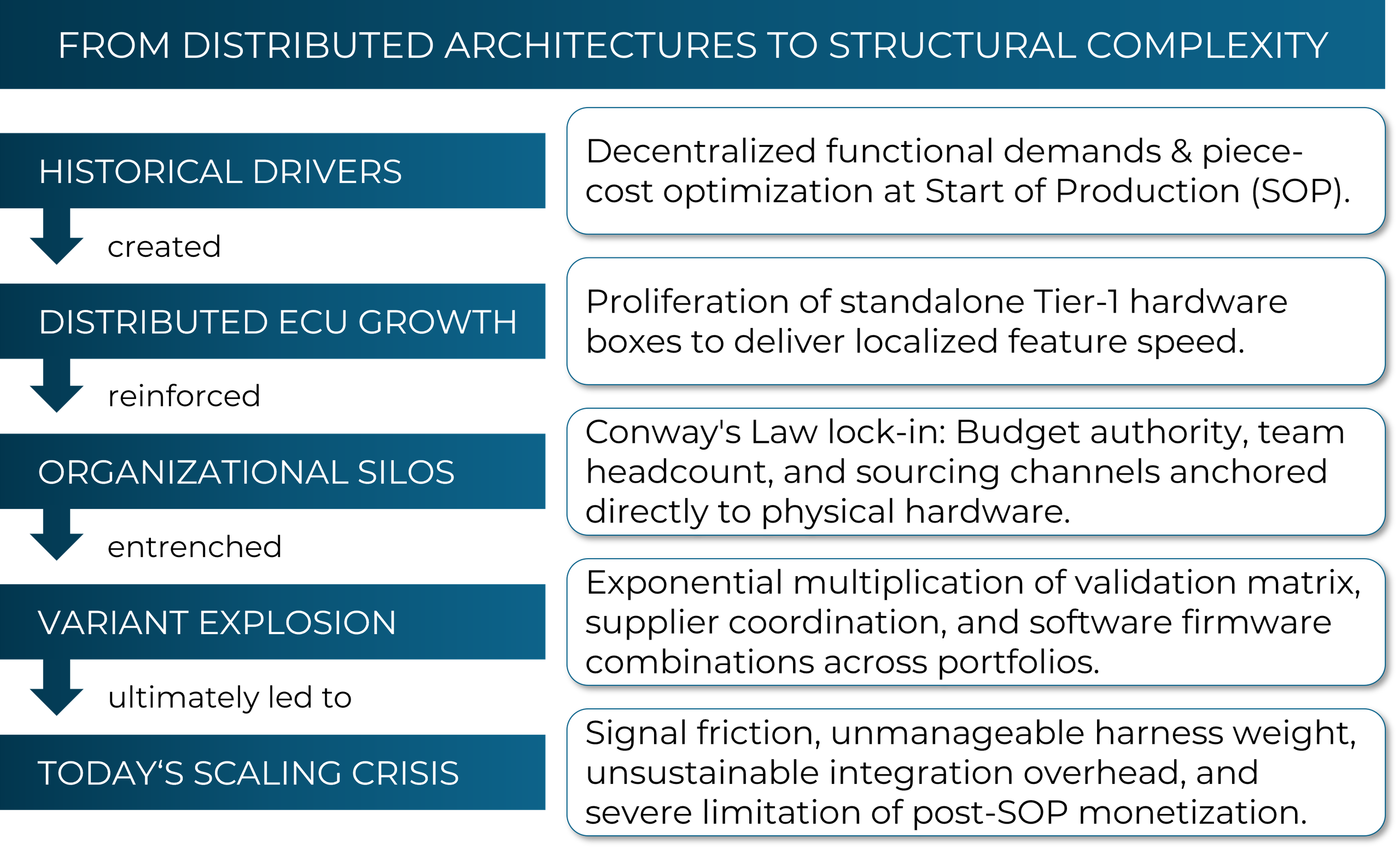
This created a self-reinforcing cycle: the traditional domain structure birthed the distributed ECU model, and the distributed ECU model, in turn, cemented the domain silos for decades. Over time, an ECU became much more than a technical component; it became a boundary of organizational responsibility, a budget line item, and a source of internal authority.
Tier-1 suppliers strongly reinforced this dynamic. Their business model was optimized around delivering complete, self-contained functional packages — combining hardware, software, and integration. This allowed OEMs to outsource technical complexity while preserving their internal domain boundaries and project-centric development cycles focused strictly on Start of Production (SOP).
While the resulting supplier ecosystem is often criticized through the lens of today’s Software-Defined Vehicle ambitions, it was highly effective within the economic and organizational realities of its time. Tier-1 suppliers accumulated deep domain expertise, accelerated feature deployment, and absorbed substantial engineering complexity on behalf of OEMs. Understanding the future transformation of automotive architectures therefore requires viewing suppliers not merely as participants in the legacy model, but as key contributors and partners to the industry’s historical scaling success.
Continue reading → The Mechanics of the Distributed Architecture Legacy explores why distributed architectures succeeded for more than three decades, how hardware, software, and networking evolved together, and how Conway’s Law embedded organizational structures directly into vehicle architectures.
The Economic Catalyst: The Illusion of Low-Cost Hardware
During the 1980s, 1990s, and early 2000s, the automotive industry experienced sustained economic growth. Rising sales volumes, strong margins, and expanding product portfolios created an environment where additional hardware was economically unproblematic. Piece costs for individual components were low, software footprints were small, and post-SOP lifecycle considerations such as over-the-air updates or continuous software maintenance played almost no role.
This paradigm rested on two critical economic dynamics:
- Transactional Monetization vs. Lifecycle Software: The domain era operated strictly on a one-time transaction model at Point of Sale the Start of Production (SOP) of the vehicle. Because digital post-sale business models — such as feature-on-demand, software subscriptions, or dynamic data monetization — did not exist, OEMs optimized hardware strictly for minimal SOP bill-of-materials (BOM) cost. Adding an inexpensive discrete minimized microcontroller was continuously favored over investing in compute with headroom.
- Portfolio Complexity and Variant Explosion: While adding standalone ECUs allowed OEMs to offer vast option catalogs, every additional ECU multiplied validation, supplier coordination, and software variant combinations across the vehicle portfolio. Because features were physically tied to discrete hardware and specific wiring configurations, option combinations generated distinct harness layouts, ECU firmware variants, and supply chain SKUs. The short-term savings on cheap hardware turned into a massive long-term operational burden across manufacturing, quality assurance, and logistics.
In this specific context, adding a new ECU was often the fastest, safest, and least risky way to introduce a new feature. But beyond piece costs, hardware carried political weight: an ECU was a physical container of organizational authority. Adding a control unit meant securing budget, expanding team headcounts, managing supplier relationships, and expanding internal power. The economic and corporate logic of the time heavily favored continuous hardware expansion over architectural consolidation.
Figure 2.2 | How Decades of Rational Local Optimization Created Today’s Scaling Crisis
Source: LOCKS Technology Consulting
Bottom-Line & Key Takeaway
The traditional distributed architecture was never just a technical design — it was the physical manifestation of departmental autonomy, internal power structures, and Tier-1 supply chains. Migrating away from it is therefore not merely a software upgrade, but an organizational transformation: you cannot consolidate the architecture without restructuring the organization that built it.
Key Strategic Insight
“Distributed architectures were not a technical mistake.
They were the logical outcome of the economic and organizational realities of their time.”
The Next Logical Step
Every architectural response in the evolutionary spiral solved the dominant constraint of its era. The next chapter examines what happens when the architecture itself becomes the constraint.
Ready to Break Historical Constraints?
From Systems Complexity to Strategic Clarity.
Legacy architectures were shaped by decades of rational decisions. The challenge today is identifying which organizational and technical assumptions are now limiting future scalability.
Glossary
- CAN (Controller Area Network): A robust, signal-based vehicle bus standard designed to allow microcontrollers and devices to communicate with each other’s applications without a host computer.
- LIN (Local Interconnect Network): A low-cost, low-speed serial network protocol used for automotive sub-networks (e.g., door modules, mirror controls).
- AUTOSAR Classic: A standardized software architecture for automotive ECUs that provides basic software modules, standardized interfaces, and an RTE to decouple applications from silicon.
- POSIX (Portable Operating System Interface): A family of IEEE standards defining APIs for operating systems (such as QNX or Linux), enabling dynamic process management and dynamic execution required for high-performance computing.
- SOME/IP (Scalable Service-Oriented Middleware over IP): An automotive middleware solution designed for control message delivery over Ethernet, establishing service-oriented communication patterns.