
Chapter 7
Artificial Intelligence in Vehicle Architecture – Demystifying the AIDV
Executive Summary
The Executive Myth vs. Reality: Most OEMs focus on AI algorithms, but models can be bought, trained, or licensed. Learning at fleet scale cannot.
Hardware Execution Reality (NPU/NCU vs. CPU/GPU): TOPS have become the new horsepower. They look impressive in presentations but rarely reveal real system efficiency.
Deterministic Safety Shields: The industry’s safety challenge is not teaching AI how to drive. It is proving when not to trust it.
Data Liquidity & Security: AI runs on data. Cybersecurity determines who controls it.
Fleet Learning Engine: The real value of automotive AI is not delivered at SOP, but through continuous learning after SOP.
1. Real-World AI Impact: Moving Past Science Fiction
While software-defined vehicle architectures are still struggling to reach maturity across the automotive industry, Artificial Intelligence (AI) is already being pushed from cloud-based applications directly into the physical vehicle platform. While the market frequently hypes the concept of the “AI-Defined Vehicle”, engineering reality dictates a more precise definition: an AI-enabled vehicle architecture.
To leverage AI effectively, executive leadership must move past hype and focus on where machine learning adds real structural, operational, and financial value to the platform today:
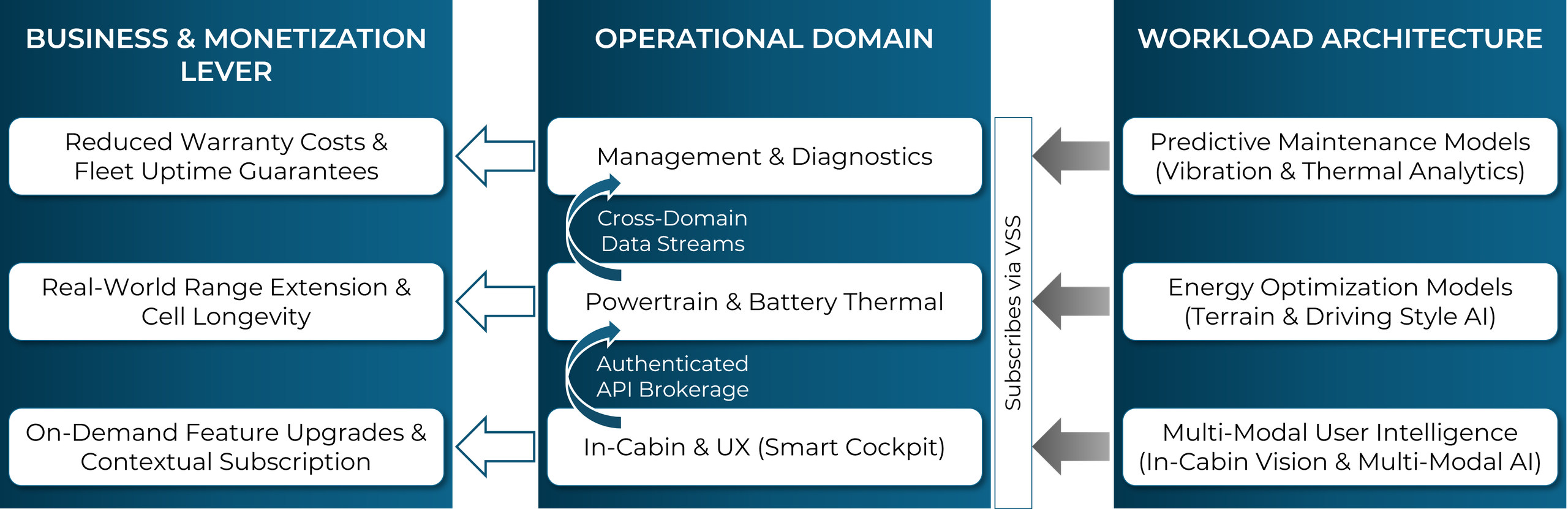
- Advanced Diagnostics & Predictive Maintenance: Analyzing complex, cross-domain data patterns in real-time to detect mechanical and electrical component degradation before a physical failure occurs.
- Context-Aware Energy Management: Utilizing neural networks to optimize battery thermal conditioning, HVAC usage, and powertrain efficiency based on real-time terrain data, driving behavior, and ambient environmental factors.
- Perception & Sensing (Exterior & Interior): Processing high-bandwidth data streams from cameras, radar, lidar, and in-cabin sensors to create a real-time model of both the vehicle’s surroundings and the cabin environment.
In all these scenarios, AI does not act as an isolated product, but as a high-performance optimization layer on top of a deterministic E/E backbone.
Figure 7.1 | The AI Value Creation Chain in Software-Defined Vehicles
Source: LOCKS Technology Consulting
2. Deterministic Safety Shields vs. Probabilistic AI
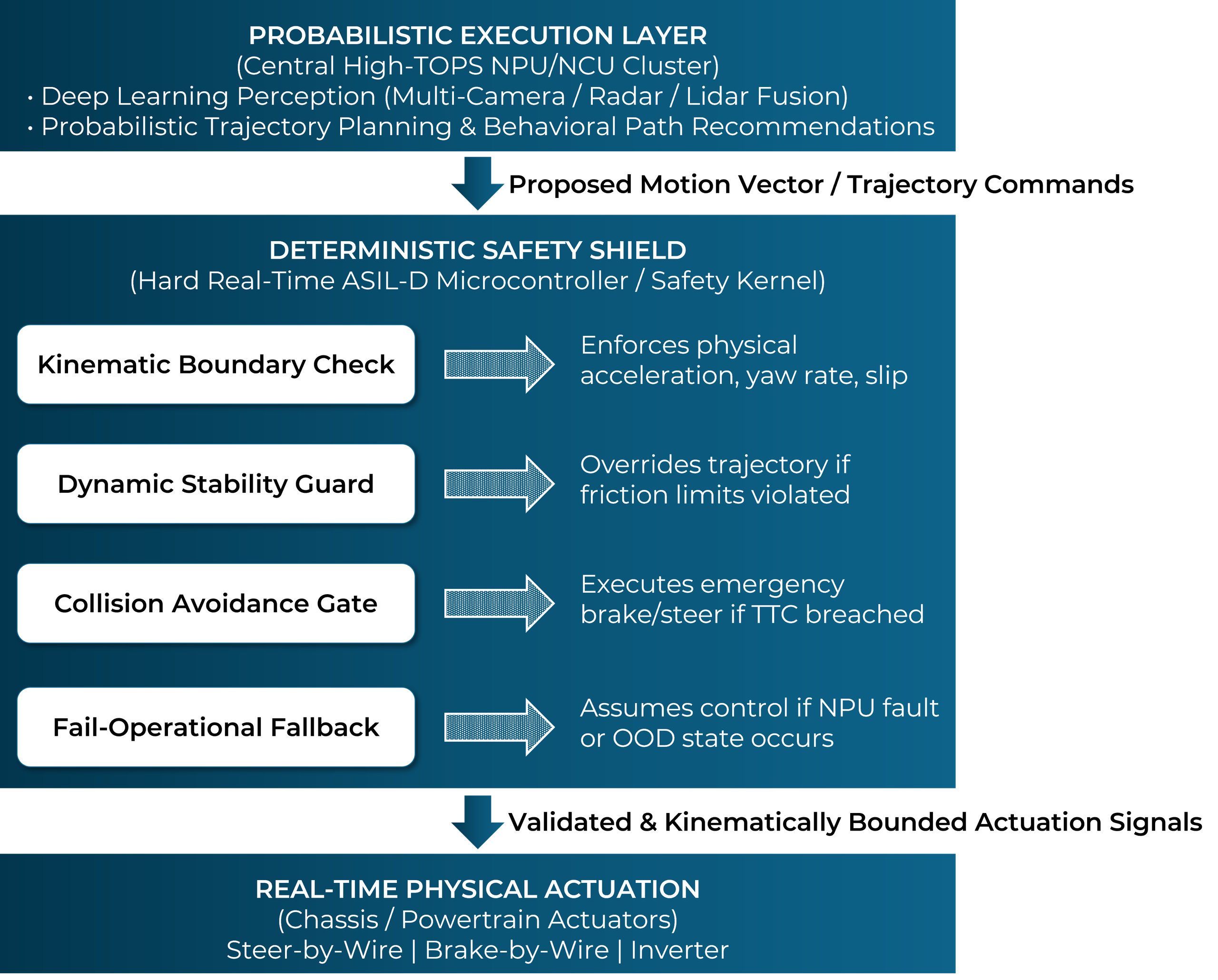
The most critical architectural boundary in an AI-enabled vehicle is the operational distinction between classical, deterministic safety logic and probabilistic AI algorithms. State-of-the-art end-to-end neural networks handle complex planning and perception. However, deep learning models remain fundamentally probabilistic — operating on statistical likelihoods rather than absolute certitude.
For safety-critical actuation (ISO 26262 ASIL-D steering, braking, and motion execution), a purely probabilistic model can never satisfy legal or functional safety requirements on its own. Advanced E/E architectures enforce a Hybrid Safety Paradigm: Current safety concepts typically bound AI-generated outputs through independent monitoring, plausibility checking, and deterministic fallback mechanisms.
Figure 7.2 | Bounding Probabilistic AI with Deterministic Safety
Source: LOCKS Technology Consulting
Continue Reading → Architectural Requirements for AI Workload Integration explores how NPU-centric compute architectures, semantic data abstraction layers, edge-to-cloud execution models, and closed-loop fleet learning pipelines enable scalable, safety-compliant AI deployment across modern Software-Defined Vehicle platforms.
3. Silicon Architecture: Evaluating Compute Paradigms for In-Vehicle AI
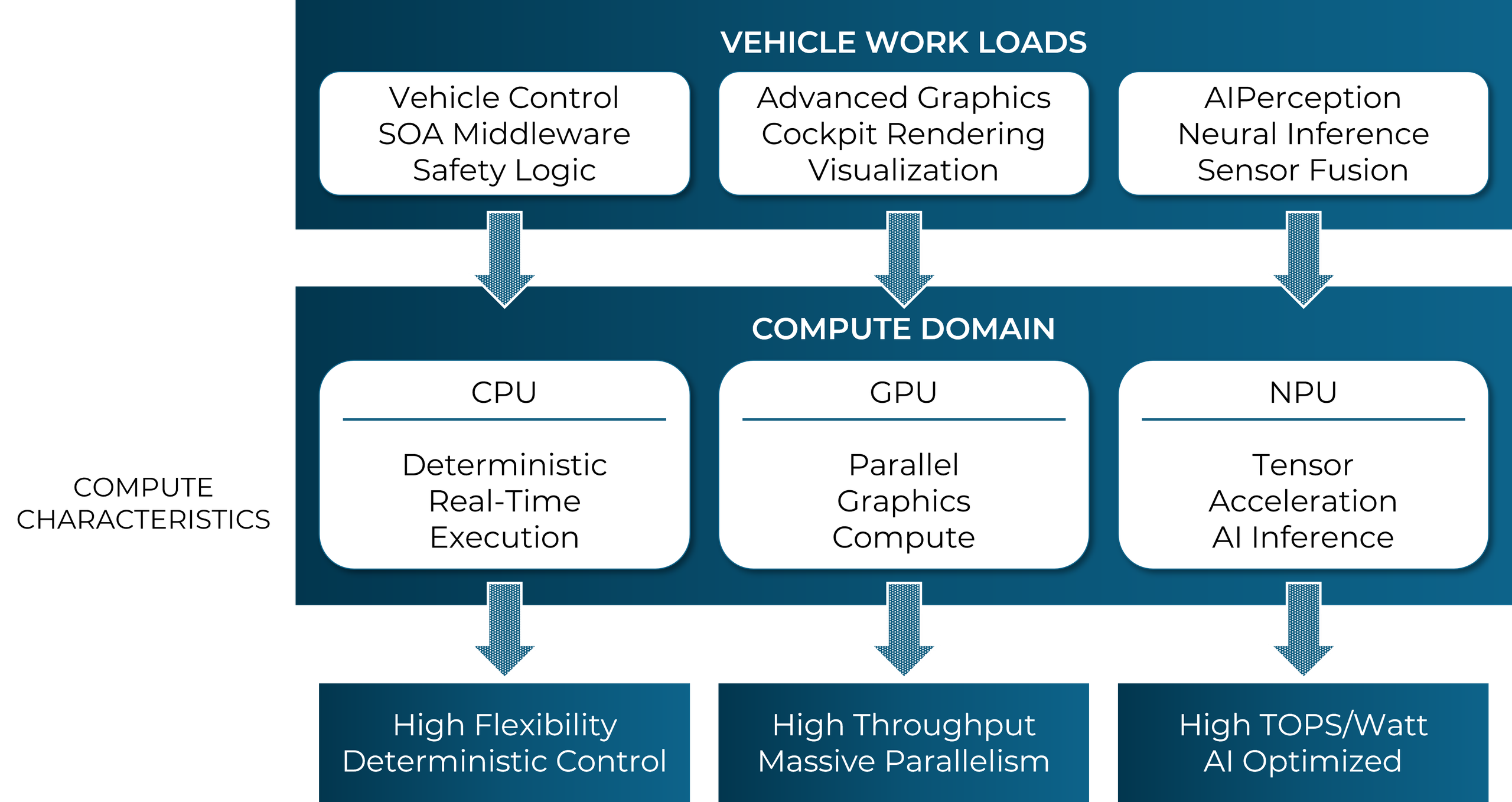
A frequent flaw in executive hardware planning is treating compute TOPS (Trillions of Operations Per Second) as a homogeneous metric. When integrating AI workloads into modern vehicle architectures, silicon selection represents a balance between flexibility, power efficiency, and thermal limits:
- General-Purpose CPUs: Capable of running control logic and lightweight inference, but typically inefficient for dense, high-throughput matrix math operations.
- GPUs (Graphics Processing Units): GPUs provide exceptional flexibility but often increase system-level power and cooling requirements. For production vehicles, memory bandwidth, data movement, and power efficiency frequently become more critical than peak TOPS figures.
- NPUs/NCUs (Neural Processing / Compute Units): Domain-specific accelerators optimized specifically for low-precision tensor operations (e.g., INT8/FP8). By focusing silicon area on systolic matrix arrays, NPUs offer an advantageous TOPS/Watt profile, making them well-suited for high-throughput edge execution within constrained power envelopes.
Executive Core Rule
The hardware bottleneck is rarely peak compute performance.
In production systems, memory bandwidth, data movement, and power efficiency typically become the dominant constraints.
Figure 7.3 | Matching AI Workloads to Automotive Compute Domains
Source: LOCKS Technology Consulting
Bottom-Line & Key Takeaway
Artificial Intelligence is an evolutionary optimization layer for vehicle capabilities, not a replacement for fundamental systems safety engineering. To successfully build an AI-enabled Vehicle architecture, executive leadership must enforce four non-negotiable architectural mandates:
- Focus on the Data Pipeline, Not Just the Model: Treat the AI model as a dynamic asset, but build the competitive moat around the hardware-aware data pipeline and automated fleet learning engine.
- Solve the Silicon & Memory Challenge: Select target silicon based on TOPS/Watt efficiency and enforce strict hardware QoS to eliminate memory bus contention between NPU inference and ASIL-D execution.
- Enforce Deterministic Bounding: Always place non-deterministic, probabilistic AI outputs behind deterministic ASIL-D safety shields and fail-operational fallback layers.
- Unify Data Liquidity and Security: Implement standardized semantic data abstraction layers (e.g., VSS) to feed AI consumers without violating UNECE R155/R156 cybersecurity boundaries.
Key Strategic Insight
“AI models create capability. Fleet learning creates sustained advantage.”
The Next Logical Step
Having established how probabilistic AI workloads can be safely integrated into deterministic, hardware-optimized vehicle architectures, the next logical step is to address the central strategic dilemma facing every automotive board: how to evaluate and balance target architecture trade-offs between radical centralization, hybrid-zonal topologies, unit BOM costs, and organizational execution capability.
Ready to Integrate AI into Your Vehicle Platform?
From Systems Complexity to Strategic Clarity.
The challenge is not deploying AI models. The challenge is integrating them safely, efficiently, and sustainably into a deterministic vehicle architecture.
Glossary
- AI-Enabled Vehicle Architecture: An E/E architectural paradigm where software-defined control loops are optimized by data-driven neural models executing across edge and central compute nodes.
- NPU/NCU (Neural Processing / Compute Unit): Domain-specific silicon accelerators engineered specifically for matrix operations, tensor computations, and high-throughput execution of deep neural networks.
- Memory Wall & QoS: The system bottleneck that occurs when high-throughput neural inference and latency-critical vehicle control logic simultaneously compete for memory bandwidth, requiring hardware-enforced quality-of-service priority rules to prevent control loop starvation.
- Deterministic Safety Shield: A hard real-time execution layer running ASIL-D safety code that continuously monitors, bounds, or overrides probabilistic AI outputs to enforce physical safety limits.
- VSS (Vehicle Signal Specification): A standardized, domain-agnostic data taxonomy developed by W3C/COVESA that translates raw vehicle signals into semantic data structures accessible by software applications and AI models.
- SOTIF (ISO 21448): Safety of the Intended Functionality — a standard addressing safety hazards resulting from functional insufficiencies, algorithmic performance boundaries, or unexpected environmental edge cases in non-faulty systems.
- Shadow Mode: An operational deployment state where candidate AI models run silently in production vehicles, comparing their predictions against human driver actions or baseline algorithms to validate safety prior to active deployment.